
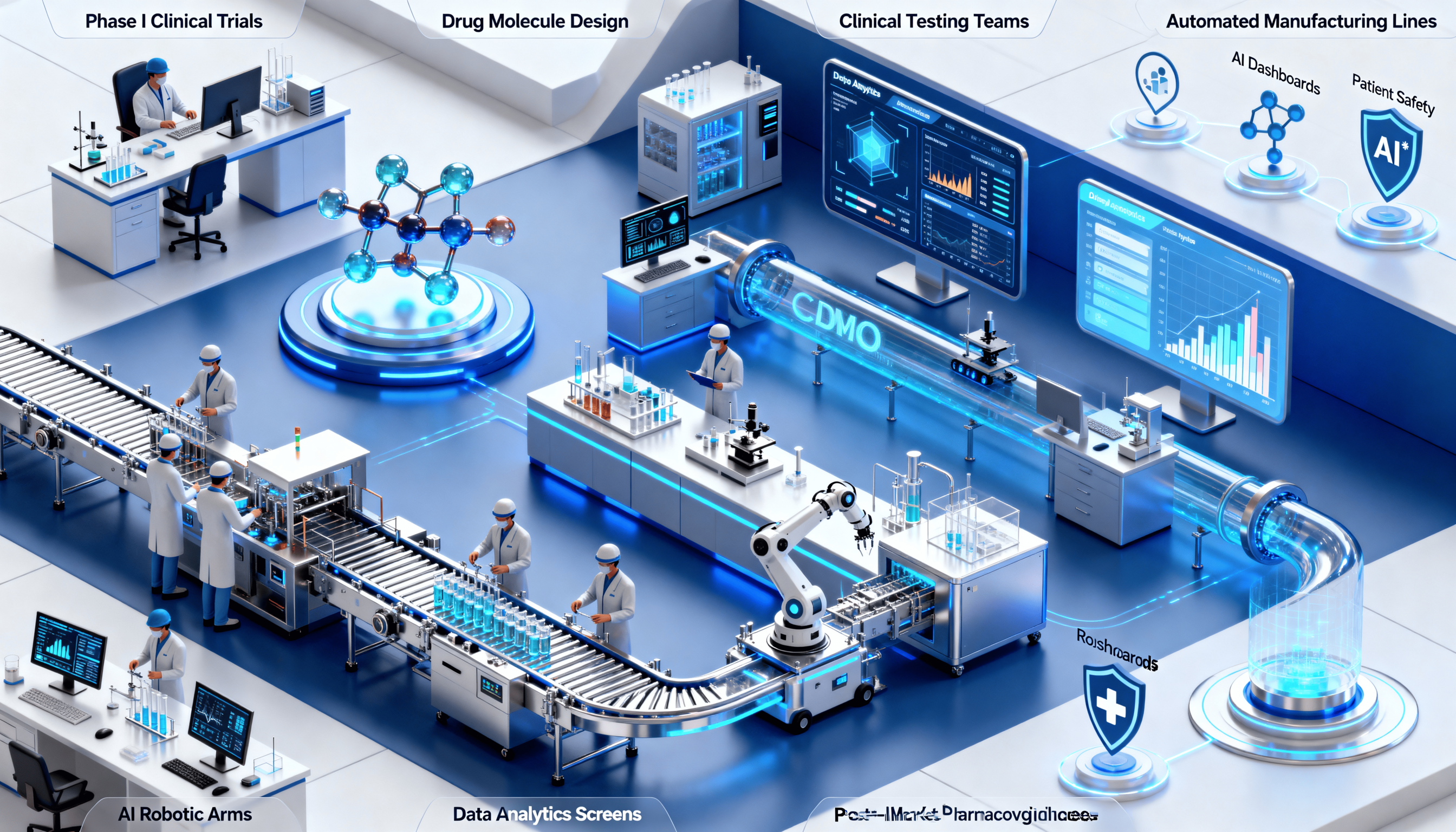
The rapidly developing pharma landscape is now thriving for more CDMOs as they bring new drugs to the market. The role may be the newest and extended in drug development, but also encompasses stages, including research, clinical management trials, regulatory support and post-market pharmacovigilance.
The growing integration of technologies like artificial intelligence in the pharmaceutical industry and machine learning in the pharma industry is occurring across operations, at the intersection of innovation, compliance and efficiency. This eventually supports clinical trials that must be conducted within the drug manufacturing process.
Understanding the Role of CDMOs in Clinical Trials
Typically, CDMOs provide end-to-end services to reputable pharmaceutical and biotech enterprises. It supports drug development and manufacturing at various levels. CDMOs play an important role in clinical trials, formulation and process development—Phase I. This is followed by commercial-scale production and pharmacovigilance, which requires drug approval.
CDMOs enable pharma companies to focus on innovation while ensuring regulatory compliance, scalability, and cost efficiency. Their services are;
- Preclinical formulation and analytical development
- Clinical trial material production
- Quality control and regulatory documentation
- Clinical supply chain management
- Post-marketing surveillance and pharmacovigilance CDMO Services
Types of Clinical Trials and CDMO Involvement
Clinical trials are mainly categorised into four phases; each with a precise aim, objectives and challenges.
Phase I: Safety and Dosage
It’s a phase involving a small group of health professionals and volunteers; evaluating the drug’s safety, dosage range and pharmacokinetics.
CDMO role:
Small-batch drug formulation and stability testing
Analytical method validation
Clinical trial material packaging and distribution
Phase II: Efficacy and Side Effects
Several patients within the phase make the drug effective and safer.
CDMO role:
Scale-up manufacturing for larger patient populations
Clinical supply chain logistics
Data collection and support for regulatory submissions
Phase III: Large-Scale Testing
Well, there are thousands of patients who get involved in multi-centre studies. This is done to confirm the efficacy and monitor for adverse reactions.
CDMO role:
Large-scale GMP (Good Manufacturing Practice) production
Batch release and quality assurance
Stability studies and global distribution
Phase IV: Post-Marketing Surveillance
Next, when the drug reaches the market, ensure long-term effects, including rare side effects. This improves the overall performance.
CDMO role:
Pharmacovigilance and adverse event reporting
Ongoing process optimisation and lifecycle management
Product reformulation or new dosage form development
Artificial Intelligence in the Pharmaceutical Industry
Artificial intelligence in the pharmaceutical industry integrated in the pharma sector—helps in drug discovery and clinical trials to be faster. It even ensures precision and cost-effectiveness. Traditionally, the newest drug development takes around 10-15 years with huge investment. Today, an artificial intelligence-powered platform that helps better predict molecular behaviour and identify potential compounds. It even helps in real-time analysis of clinical data.
Key applications of AI in pharmaceuticals include:
Drug Discovery and Development
There are vast datasets and chemical libraries that are almost accessible with AI. This even helps in predicting drug target interactions and supports in optimising for lead compounds. This eventually shortens the R&D timelines.
- Machine learning algorithms help identify patterns in biological data.
- Deep learning tools help in better stimulation for molecular structures to forecast toxicity and efficacy.
Clinical Trial Design and Recruitment
Artificial intelligence streamlines care for patients. This happens by matching candidates to trial criteria—using electronic health records, genomic data, and more. It ensures diversity and faster enrolment.
Predictive Analytics for Safety Monitoring
AI and machine learning support detecting safety signals. It even supports better drug reactions in real time. So, enhancing pharmacovigilance helps.
Supply Chain Optimisation
AI-driven predictive models help CDMOs manage raw materials, reduce waste, and forecast production demands more accurately.
Quality Control Automation
Automated vision systems and AI algorithms detect deviations in manufacturing and ensure compliance with regulatory standards.
As AI isn’t replacing human expertise, it is rather augmenting it. This, when combined with CDMO services, brings a powerful synergy, accelerating the drug development. It even helps in maintaining precision and patient safety.
AI in Drug Discovery and Development: A New Era
Recently, ai in drug discovery and development has become an inseparable part of drug development and discovery. Previously, it relied on trial-and-error with time-consuming lab testing solutions. Artificial intelligence supports better predictions of biological activity. It even helps in analysing the chemical structuring of drugs, keeping vast datasets collected in hours rather than months.
Examples of AI-driven innovation in drug development include:
- Target Identification
- Lead Optimization
- Preclinical Testing
Importance of Pharmacovigilance in Drug Development
The moment drugs are launched patient safety is maintained through PV (pharmacovigilance). This involves monitoring, assessing and preventing the adverse effects.
Key functions of pharmacovigilance include:
- All-time monitoring of adverse drug reactions (ADRs)
- Data collection from healthcare providers, patients, and literature
- Signal detection and risk assessment
- Precise reporting to global regulatory authorities such as the FDA, EMA, and CDSCO
Why importance of pharmacovigilance matters:
- Patient Safety
- Regulatory Compliance
- Trust and Transparency
- Product Improvement
The Future of CDMOs in an AI-Driven Clinical Landscape
Typically, the future of clinical research lies in trends and in smart partnerships between the pharmaceutical industry and tech-enabled CDMOs. Some emerging trends include:
- AI-integrated CDMO Platforms
- Predictive Quality Assurance
- Virtual Clinical Trials
- Sustainability and Efficiency
The Final Verdict
Whether it’s Phase I clinical trials to post-market PV, CDMOs like Pinnacle Life science share indispensable partners in the advanced pharmaceutical ecosystem. The ability to integrate an AI-driven tool enhances the drug lifecycle, from molecule design to patient monitoring. AI continues to transform CDMOs, accelerating drug development and redefining quality, compliance, and patient care standards.
FAQs
How do CDMOs support pharmaceutical companies during clinical trials?
CDMOs ensure end-to-end support that includes medication formulation development, manufacturing within precise clinical trials, quality testing & regulatory documentation. It helps in managing supply chains, ensuring compliance with good manufacturing practices, and facilitating a smoother trial execution.
What role does AI play in drug discovery and clinical development?
Well, AI helps in better acceleration for drug manufacturers. This is followed by analysing biological data. From optimising clinical trials to pharmacovigilance monitoring, everything is easily managed with artificial intelligence.
Why is pharmacovigilance important after drug approval?
That’s really worthy as it helps in ensuring the ongoing safety of patients. It supports real-time monitoring and assessment of adverse drug reactions. Pharmacovigilance helps maintain regulatory compliance and continuous product improvement. It therefore builds trust with patients and healthcare professionals.
