
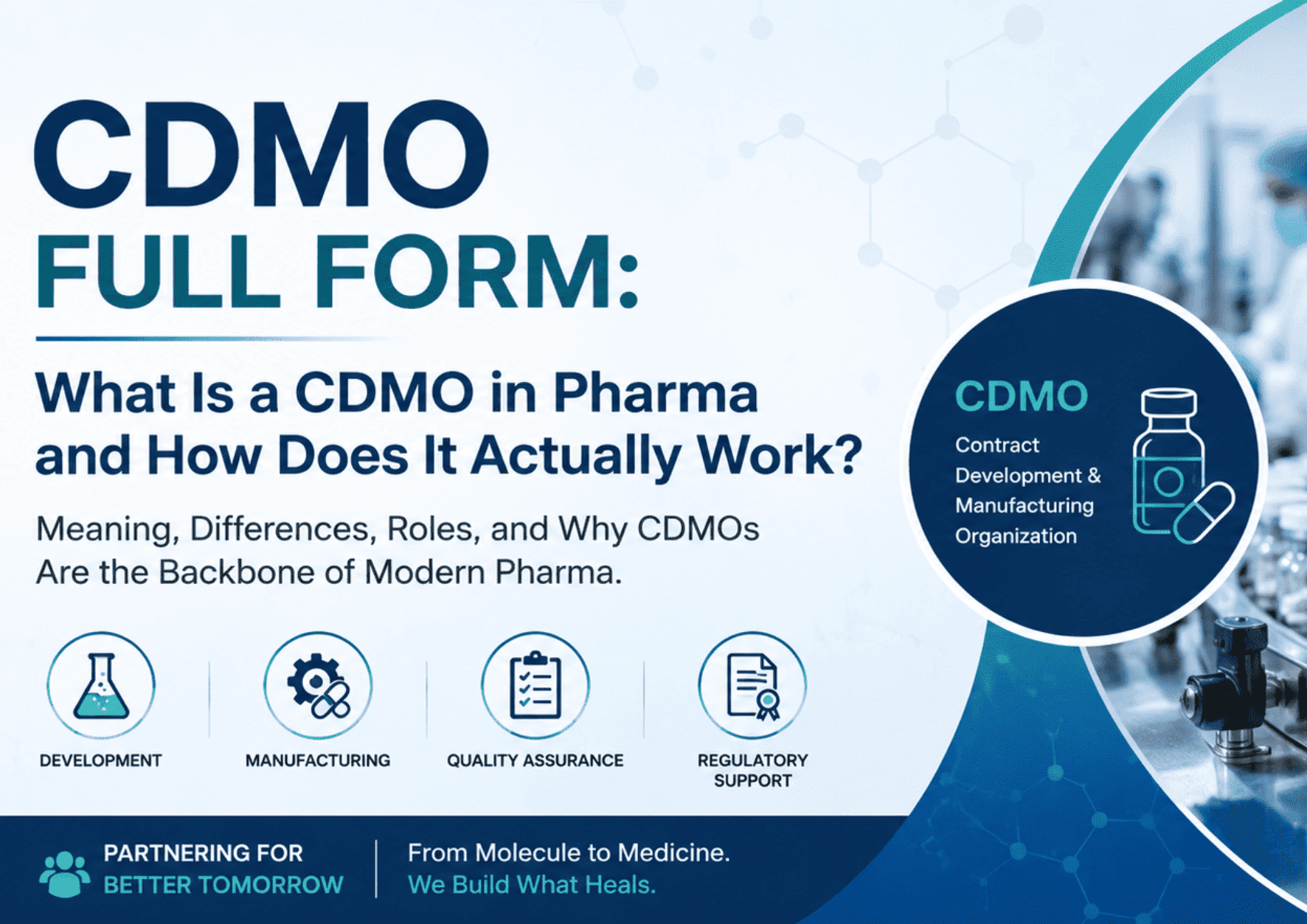
If you’ve landed here searching “CDMO full form,” here’s the short answer first, then the longer version that’s actually worth your time.
CDMO stands for Contract Development and Manufacturing Organization. It’s a company that pharma and biotech firms hire to develop and manufacture their drugs, so the brand itself doesn’t have to build its own factory or run its own formulation lab. The brand focuses on R&D and marketing. The CDMO handles the science and the production line.
That’s the textbook definition. But most people landing on this page aren’t just curious about an acronym – they’re trying to figure out if a CDMO is even something their company needs. So let’s get into that.
CDMO Meaning, in Plain Language
Say there’s a small biotech that’s discovered a promising molecule for treating a specific type of cancer. Early lab studies look good. What they don’t have is a manufacturing plant, a quality control lab, or a regulatory team that knows how to file paperwork for India, the US, and Europe all at once.
Building that from scratch would take years and cost more money than most companies their size actually have. So they go to a CDMO instead. The CDMO takes the molecule, works out how to formulate it properly, figures out how to manufacture it at scale without it behaving any differently, runs the quality tests, and eventually produces commercial batches once the drug clears approval.
That’s the whole model in one paragraph. Not glamorous, but it’s basically the backbone of how most of the world’s medicine gets made.
CDMO vs CMO: What’s the Real Difference?
This is the question that comes up the most, so let’s just settle it.
A CMO (Contract Manufacturing Organization) only manufactures. You hand them a finished formulation and a validated process, they produce it. That’s the job, full stop.
A CDMO does that too, but also does the development work before manufacturing even starts – formulation, stability testing, analytical method development, all under one roof, with the same team that later runs commercial production.
Why does that matter? Because when development and manufacturing sit in two separate companies, things get lost in translation. The team that designed the process isn’t the team running it, and small details slip through. When it’s one CDMO doing both, there’s no handoff, no re-explaining, no guessing games.
So in short, CMO and CDMO aren’t the same thing even though people throw the terms around like they are. A CDMO is the bigger, more complete version of that relationship.
CDMO vs CRO: Don’t Mix These Up Either
While we’re on acronyms – here’s another one people confuse with CDMO.
A CRO (Contract Research Organization) handles clinical research. Trial design, patient data, regulatory filings for human studies. They don’t manufacture anything.
A CDMO is the one actually making the drug – both during clinical trials, so there’s something to test on patients, and after approval, at commercial scale.
Some companies end up working with both a CRO and a CDMO on the same drug, at different stages. And a few CDMOs now offer some clinical-stage support too, which blurs the line a bit. But the core difference holds – CRO researches, CDMO builds.
What Does a CDMO Company in Pharma Actually Do, Day to Day?
Here’s where the textbook definition turns into real work. A typical CDMO is involved in:
Formulation development – the unglamorous part where you figure out the right dosage form, tablet or capsule or injectable, and make sure it stays stable on a shelf for two or three years.
Analytical testing – chemists build and run the exact tests that confirm every batch meets purity and safety specs before it goes anywhere near a patient.
Clinical trial manufacturing – producing the actual drug supply used in Phase I, II, and III studies, usually in much smaller, tightly controlled batches than commercial runs.
Technology transfer – the tricky bit of scaling something from a lab-sized batch to a full commercial batch without the drug behaving differently.
Commercial-scale manufacturing – once it’s approved, producing it in real volume for real markets.
Regulatory documentation – since the CDMO holds most of the technical process knowledge regulators actually want to see.
Some CDMOs do all of this under one roof. Others specialize narrower, like high-potency oncology compounds that need dedicated containment most regular facilities just aren’t built for.
Is Pfizer a CDMO?
No, not really. Pfizer is one of the world’s biggest pharma companies – meaning it researches, develops, markets, and sells its own branded drugs. A CDMO exists specifically to develop and manufacture drugs on behalf of other companies, under contract.
That said, some large pharma companies do run manufacturing divisions that take on contract work for others, almost as a side business using up spare capacity. So the line isn’t always perfectly clean. But Pfizer’s core identity is an innovator pharma company, not a CDMO.
Is Cipla or Dr. Reddy’s a CDMO?
People searching “biggest CDMO in India” often end up asking about names like Cipla or Dr. Reddy’s, since they’re so well known. Honest answer – not primarily.
Cipla and Dr. Reddy’s are branded pharmaceutical companies. They develop and sell drugs under their own name, same as Pfizer does globally. CDMO-type work might exist somewhere inside a giant pharma company’s operations, but it isn’t the main business or what they’re built around.
India’s actual CDMO landscape has both dedicated CDMO players and pharma companies running CDMO divisions on the side. The honest way to figure out “who’s biggest” isn’t brand recognition – it’s checking which facility actually holds the right approvals and capacity for your specific drug, because that’s what decides whether they can do your job at all.
Why India Has Become Such a Big CDMO Hub
This didn’t happen by accident. Indian CDMOs have spent the last decade building facilities that hold USFDA, EU-GMP, and other major approvals, while still running at a cost base way lower than the US or Europe. Global-standard quality at a lower price – that combination is genuinely hard to find elsewhere.
Within India, oncology has become a particularly specialized corner of this market. Cytotoxic and high-potency drugs need containment infrastructure most general-purpose factories simply don’t have, so the companies that built specifically for this, instead of retrofitting an old plant, tend to stand out. Pinnacle Life Science is one such CDMO that built its facility around oncology manufacturing from day one, rather than adding it on later.
How to Actually Choose a CDMO (Not Just What One Is)
If you’ve made it this far, you’re probably past “what does CDMO mean” and into “okay, but how do I pick one.” A few honest questions worth asking before signing anything:
What regulatory approvals does their facility actually hold, and for which markets specifically? “Global compliance” as a phrase means nothing – ask for the named approval for the country you’re targeting.
Have they actually made your type of drug before, not just something loosely in the same category? Solid tablets and sterile injectables are completely different worlds.
What’s the real timeline from signing to first batch, based on a comparable project they’ve actually finished – not a best-case number from a sales deck?
Who manages the handoff between development and manufacturing? Same team end to end is a good sign. Separate departments that barely talk to each other is where things usually go wrong.
Frequently Asked Questions
What is the CDMO full form?
CDMO stands for Contract Development and Manufacturing Organization – a company that handles both drug development and manufacturing for pharma and biotech clients under one contract.
What is the difference between CMO and CDMO in pharma?
A CMO only manufactures a drug that’s already fully developed. A CDMO does the development work too – formulation, testing, process design – before manufacturing it, all under the same roof.
Are CDMO and CMO the same?
No. They’re related but not identical. Every CDMO can technically do what a CMO does, but not every CMO can do what a CDMO does, since CMOs usually don’t offer development services.
What is the difference between CDMO and CRO?
A CRO handles clinical research and trial management. A CDMO handles the actual drug development and manufacturing. Different stages of getting a drug to market.
Is Pfizer a CDMO?
No. Pfizer is a branded pharmaceutical company that develops and sells its own drugs. CDMOs exist specifically to manufacture and develop drugs for other companies under contract.
Is Cipla a CDMO company?
Not primarily. Cipla is a branded pharmaceutical company, like Pfizer, rather than a dedicated contract development and manufacturing organization.
Which is the largest CDMO company in India?
There’s no single agreed “largest,” since it depends on whether you’re measuring revenue, facility size, or therapeutic specialization. What actually matters for picking a partner is whether they hold the right approvals and experience for your specific drug – not how big the brand name is.
फार्मा में सीएमओ और सीडीएमओ में क्या अंतर है?
सीएमओ केवल पहले से तैयार की गई दवा का निर्माण करता है। सीडीएमओ निर्माण के साथ-साथ दवा के डेवलपमेंट का काम भी करता है, जैसे फॉर्मूलेशन और टेस्टिंग, यह सब एक ही कंपनी के अंदर होता है।
Looking for an Oncology CDMO Partner?
If you’re evaluating CDMO partners for an oncology program specifically, the questions above are a decent starting point for any vendor conversation. At Pinnacle Life Science, our facility is built around oncology and high-potency manufacturing from the ground up, including OEB Level 5 containment for USFDA-compliant operations. We’ve also written a more detailed CDMO vs CMO comparison specifically for oncology manufacturing if you want to dig deeper. Feel free to get in touch if you’d like to talk through your specific requirements.
