
Last updated: November/2026
Quick note: In pharma, CDMO most often stands for Contract Development and Manufacturing Organization. In some Indian government health departments, CDMO also refers to a Chief District Medical Officer. This guide covers the pharma meaning.
What Is the CDMO Full Form in Pharma?
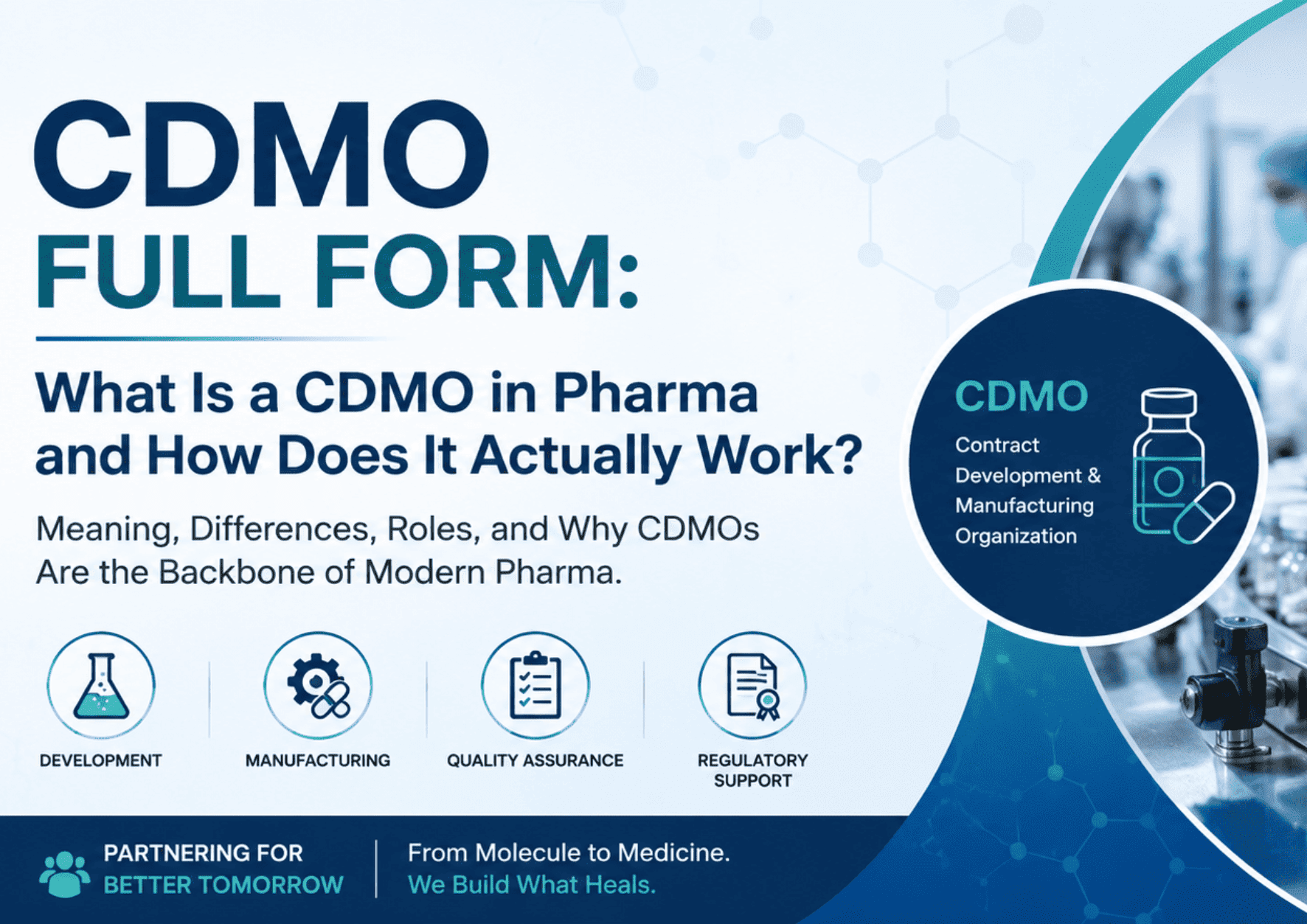
CDMO stands for Contract Development and Manufacturing Organization. In the pharmaceutical industry, it is a company that provides drug development and manufacturing services to pharmaceutical and biotech companies under a contract.
Depending on the CDMO’s capabilities and the agreed scope, these services can include formulation development, process development, analytical testing, technology transfer, clinical trial material production and commercial-scale manufacturing.
In simple terms: a drug company partners with a CDMO when it needs outside scientific expertise, manufacturing infrastructure or specialised production capability without building every one of those in-house. If you want the broader picture of outsourcing first, start with our plain guide to pharmaceutical contract manufacturing.
Most people reading this are not just curious about an acronym. They are trying to work out whether their company needs a CDMO, and how to pick a good one. So this guide covers both.
On this page
- What does CDMO mean in pharmaceutical manufacturing?
- How does a CDMO work? The development lifecycle
- What does a pharmaceutical CDMO do?
- CDMO vs CMO vs CRO vs CRAMS
- Drug substance vs drug product
- Types of CDMOs
- Why do pharmaceutical companies use a CDMO?
- How to choose the right pharmaceutical CDMO
- Regulatory and quality standards to evaluate
- The role of a CDMO in oncology manufacturing
- Why India is an important CDMO destination
- Glossary
- FAQs
What Does CDMO Mean in Pharmaceutical Manufacturing?
A CDMO is an outsourced development and manufacturing partner. The drug company (often called the sponsor) usually focuses on R&D, regulatory strategy and marketing. The CDMO handles formulation science and production.
Say a small biotech has found a promising molecule for a specific type of cancer. Early lab studies look good. What they do not have is a manufacturing plant, a quality control lab, or a team that knows how to prepare filings for India, the US and Europe at the same time.
Building all that takes years and more money than most companies of that size have. So they hire a CDMO. The CDMO works out how to formulate the molecule, scales up the process without the drug behaving differently, runs the quality tests and, depending on the programme and contract, manufactures clinical batches and later commercial batches once the product is authorised.
One thing worth saying clearly: outsourcing manufacturing does not remove responsibility. Under CGMP, both the drug owner and the contract facility have defined responsibilities. A quality agreement spells out who does which activities, but it does not simply hand all statutory responsibility to one party. More on this in the quality section below.
How Does a CDMO Work? The Drug Development Lifecycle
A CDMO project typically moves from early development to commercial supply. The sequence below is illustrative. Scope, order and clinical phases vary by product and contract. To see where manufacturing fits in the bigger picture, read our guide to the oncology drug development process.
- Drug development: pre-formulation, feasibility and formulation work
- Analytical development: test methods and specifications
- Process development: a reproducible, scalable manufacturing process
- Technology transfer: moving the process and documentation to the manufacturing site
- Clinical manufacturing: material for clinical studies
- Process validation: evidence that the commercial process performs consistently
- Commercial manufacturing: routine production, quality control and batch release
| Stage | What happens | What the CDMO delivers | What the sponsor should check |
|---|---|---|---|
| Drug development | Pre-formulation, feasibility, formulation | A stable formulation suited to the dosage form | Experience with the same dosage form |
| Analytical development | Methods and specifications are established | Test methods for identity, strength and purity | Method validation approach |
| Process development | Process is optimised for reproducibility and scale | A defined, repeatable process | Scale-up track record |
| Technology transfer | Process and documents move to the site | Transfer documents, equipment fit assessment | Who owns the handoff |
| Clinical manufacturing | Material is made for clinical studies | Controlled batches, usually smaller | Batch records, release process |
| Process validation | Commercial process is shown to be consistent | Validation protocols and reports | Validation plan and timelines |
| Commercial manufacturing | Routine production and batch release | Product in volume | Capacity, supply continuity |
A note on validation: process validation is a lifecycle approach. Process performance qualification (PPQ) is one part of it, usually the stage where the commercial process is demonstrated at scale. It is not another name for the whole of process validation.
What Does a Pharmaceutical CDMO Do?
A pharmaceutical CDMO provides contracted drug development and manufacturing services to pharmaceutical and biotechnology companies. Depending on its capabilities and the agreed scope, these may include formulation development, analytical testing, process development, technology transfer, clinical manufacturing and commercial production.
Capabilities differ between providers, so never assume one CDMO offers everything.
Drug development and formulation. Choosing the dosage form (tablet, capsule or injectable) and making sure it stays stable through its shelf life. See Pinnacle’s research and development capabilities.
API development and manufacturing. Developing and producing the active pharmaceutical ingredient, where the CDMO has that capability.
Analytical development and testing. Building and running the tests that confirm each batch meets its specifications.
Process development and optimisation. Making the process reproducible so batch one and batch one hundred behave the same way.
Technology transfer. Moving a process from lab or pilot scale to the production site, with documentation, equipment suitability checks and scale-up planning.
Clinical trial manufacturing. Producing material for clinical studies, usually in smaller, tightly controlled batches.
Commercial-scale manufacturing. Producing the approved product in volume. Details of Pinnacle’s manufacturing infrastructure are on our infrastructure page.
Quality assurance and regulatory support. GMP systems, documentation, audits and CMC support for filings. See Pinnacle’s quality systems.
Looking for a pharmaceutical manufacturing partner?
See how Pinnacle Life Science supports oncology manufacturing.
CDMO vs CMO vs CRO vs CRAMS
A CMO (Contract Manufacturing Organization) manufactures. You hand over a developed formulation and a defined process, and it produces the product.
A CDMO also handles development before manufacturing, such as formulation, stability work and analytical method development, often with the same team that later runs production. That continuity matters, because when development and manufacturing sit in two companies, details can get lost in the handoff. That said, many CMOs also offer development services, so always ask what is actually included.
A CRO (Contract Research Organization) provides research services. Depending on the provider, these can include preclinical research, clinical operations, data management and related support. A CRO does not generally manufacture the drug.
CRAMS (Contract Research and Manufacturing Services) is a term common in the Indian industry. It describes integrated research and manufacturing services, and the scope varies by company.
| CDMO | CMO | CRO | CRAMS | |
|---|---|---|---|---|
| Full form | Contract Development and Manufacturing Organization | Contract Manufacturing Organization | Contract Research Organization | Contract Research and Manufacturing Services |
| Primary focus | Development and manufacturing | Manufacturing | Research and clinical services | Research and manufacturing |
| Development work | Yes, depending on scope | Not necessarily | Research oriented | Depends on scope |
| Makes the drug? | Yes | Yes | Not generally its core role | Yes |
| Typical work | Formulation, process development, production | Production | Preclinical and clinical research | Integrated research and production |
These categories are not rigid. Check the actual contract scope instead of relying on the label.
For a deeper look at the first two, read our CDMO vs CMO comparison for oncology manufacturing.
Drug Substance vs Drug Product
Drug substance is the active component of the medicine. For small-molecule drugs this is the API. For biological products it is the biological active substance, which is not always described simply as an API.
Drug product is the finished dosage form the patient takes, such as a tablet, capsule or injection.
Some CDMOs work on one side and some cover both. Make sure the CDMO you talk to covers the side your programme needs.
Types of CDMOs
- Small-molecule CDMOs, covering tablets, capsules and injectables
- Biologics CDMOs, working on antibodies, vaccines and other cell-based products
- High-potency and oncology CDMOs, built around containment for compounds that are hazardous to handle (see our guide to OEB Level-5 containment in oncology manufacturing)
- ADC CDMOs, handling an antibody plus an ultra-potent payload, which needs both biologics and containment expertise
Some CDMOs cover several of these. Others specialise narrowly and do it well.
Why Do Pharmaceutical Companies Use a CDMO?
A CDMO usually makes sense when:
- You do not own a manufacturing site and do not want to build one yet
- You need to scale from clinical batches to commercial supply
- Your compound needs specialised containment you cannot easily build
- You want a second source of supply
- You lack regulatory or tech-transfer experience in a target market
If none of that applies, in-house manufacturing may still be the better call.
How to Choose the Right Pharmaceutical CDMO
Ask these before signing anything:
- What is the facility’s inspection history and what approvals does it hold, for which markets? “Global compliance” means nothing. Ask for named, current documentation for your target country.
- Have they made your type of drug before? Solid tablets and sterile injectables are different worlds.
- What is the real timeline from signing to first batch? Ask for a comparable finished project, not a best-case number from a sales deck.
- Who manages the handoff between development and manufacturing? The same team end to end is a good sign.
- Can they show evidence, and will they let you audit? For potent compounds, ask for the containment assessment and plan a site audit.
Buyers also increasingly ask for supply chain visibility (including where the API comes from) and flexibility from clinical to commercial scale.
For a scoring framework and red flags, read how to choose a CDMO for OEB 4 and OEB 5 compounds. For the equipment side, see our HPAPI suite equipment checklist.
What Regulatory and Quality Standards Should You Evaluate?
This is where marketing claims and facts often get mixed up. An inspection, an approval and an establishment registration are not the same thing. Ask which one the CDMO is actually talking about, and ask for current documentation.
Things worth verifying:
- cGMP compliance at the specific site that will make your product
- Inspection history with US FDA, EU-GMP or other regulators relevant to your target markets, including how any observations were addressed
- QA and QC systems, including batch manufacturing records
- Analytical method validation, process validation and stability studies
- Deviation management and CAPA, and how change control is handled
- A written quality agreement that defines each party’s responsibilities, plus audit rights
The FDA’s guidance on contract manufacturing arrangements for drugs and quality agreements explains why the owner and the contract facility should define responsibilities in writing. The ICH quality guidelines, such as Q7 and Q10, are also useful references for GMP and quality systems.
For Pinnacle’s own setup, see our quality infrastructure.
What Is the Role of a CDMO in Oncology Drug Manufacturing?
Oncology drugs are often cytotoxic or highly potent, which changes how a facility has to be designed and run. A general-purpose plant is usually not built for it.
Key terms:
- HPAPI means high-potency active pharmaceutical ingredient. Very small exposures can matter. Our HPAPI suite equipment checklist covers what such a suite needs.
- OEB (Occupational Exposure Band) is a risk-banding approach used to decide how tightly exposure must be controlled. Band definitions and exposure ranges can vary between organisations, so it is not one universal regulatory classification. Higher bands generally call for stricter containment. Read more on OEB Level-5 containment.
- Isolators separate the operator from the product. How well they contain depends on design, pressure regime, transfer systems, glove integrity, operating procedures and validation, not just on having an isolator.
- Cross-contamination control and cleaning validation protect both patients and staff.
- Handling and dispensing of potent APIs needs its own procedures and equipment.
As an illustration, an oncology oral solid dose product may move through API dispensing, granulation, tablet compression, film coating and primary packaging, where those steps apply. In a high-potency programme, containment has to be considered at each step.
Pinnacle Life Science at a glance
Pinnacle Life Science is an oncology-focused CDMO headquartered in Mumbai. It operates a manufacturing facility in Baddi, Himachal Pradesh, with capabilities for oncology oral solid dosage manufacturing (tablets and capsules) and high-potency programmes using isolator-based containment systems. You can see more on our products and infrastructure pages.
Discuss your oncology manufacturing requirements
Evaluating an oncology manufacturing partner? Use the checklist above on us too, ask for the evidence, and talk to our team about your project.
Why India Is an Important CDMO Destination
Many Indian manufacturers have built facilities that have been inspected by regulators such as the US FDA and assessed against standards like EU-GMP, on a cost base that is typically lower than in the US or Europe. Quality plus cost is a hard combination to find elsewhere. Inspection outcomes differ by site, so always check the specific facility.
Within India, oncology has become a specialised corner of the market. Cytotoxic and high-potency drugs need containment infrastructure that general plants lack, so purpose-built facilities stand out. For a wider comparison, read Pharmaceutical Contract Manufacturers in India: Complete Guide 2026, or see our page on oncology medicine manufacturers in India.
CDMO Glossary
| Term | Meaning |
|---|---|
| API | Active Pharmaceutical Ingredient, the active component of a small-molecule drug |
| cGMP | Current Good Manufacturing Practice |
| HPAPI | High-Potency Active Pharmaceutical Ingredient |
| OEB | Occupational Exposure Band, a risk-banding approach for exposure control |
| CMC | Chemistry, Manufacturing and Controls, the part of a filing covering product quality |
| CAPA | Corrective and Preventive Action, the system for fixing and preventing quality issues |
| PPQ | Process Performance Qualification, a stage within process validation |
| CRAMS | Contract Research and Manufacturing Services |
Frequently Asked Questions
What is the CDMO full form in pharma?
CDMO stands for Contract Development and Manufacturing Organization. It is a company that provides drug development and manufacturing services to pharma and biotech clients under contract.
What does a CDMO company do?
A CDMO supports pharma and biotech companies with development and manufacturing. Depending on its capabilities, this can include formulation, analytical testing, process optimisation, technology transfer, clinical trial material and commercial production. See the full list in what a pharmaceutical CDMO does.
What is the difference between CMO and CDMO in pharma?
A CMO focuses on manufacturing a drug that is already developed. A CDMO also does development work such as formulation, testing and process design before manufacturing. Some CMOs offer development too, so check the scope. Our CDMO vs CMO guide goes deeper.
Are CDMO and CMO the same?
No. A CDMO covers development and manufacturing, while a CMO is mainly a manufacturer. The scope varies by company, so compare what each one actually offers.
What is the difference between CDMO and CRO?
A CRO provides research services such as preclinical research, clinical operations and data management. A CDMO handles drug development and manufacturing. They serve different stages of getting a drug to market.
What is CRAMS in the pharmaceutical industry?
CRAMS stands for Contract Research and Manufacturing Services. It describes integrated research and manufacturing services, common in the Indian industry.
What is technology transfer in pharma manufacturing?
It is the documented movement of a process from development to a manufacturing site, including scale-up and equipment suitability checks.
What is the difference between API and drug product manufacturing?
API manufacturing makes the active ingredient. Drug product manufacturing turns it into the finished dose, such as a tablet or injection.
What is an oncology CDMO?
A CDMO focused on cancer drugs, with facilities and processes built to handle cytotoxic and high-potency compounds safely. Learn how to choose a CDMO for OEB 4 and OEB 5 compounds.
What is HPAPI manufacturing?
Manufacturing of high-potency active ingredients, which needs strict containment controls such as isolators, defined exposure limits and validated procedures. See the HPAPI suite equipment checklist.
What should you check before selecting a CDMO?
Current documentation of market approvals and inspection history, experience with your dosage form, realistic timelines, the development-to-manufacturing handoff, and audit access.
Is Pfizer a CDMO?
Primarily no. Pfizer is a research-based pharmaceutical company that develops and sells its own drugs. It has offered contract manufacturing to others through its CentreOne unit, but CDMOs as a category exist to develop and manufacture drugs for others under contract.
Is Cipla a CDMO company?
Not primarily. Cipla is a branded pharmaceutical company rather than a dedicated CDMO.
Which is the largest CDMO company in India?
There is no single agreed answer. It depends on whether you measure revenue, facility size or specialisation. What matters for your project is whether the CDMO has the right approvals and experience for your drug. Our guide to pharmaceutical contract manufacturers in India compares the landscape.
फार्मा में सीएमओ और सीडीएमओ में क्या अंतर है?
सीएमओ केवल पहले से तैयार की गई दवा का निर्माण करता है। सीडीएमओ निर्माण के साथ-साथ दवा के डेवलपमेंट का काम भी करता है, जैसे फॉर्मूलेशन और टेस्टिंग। लेकिन हर कंपनी का स्कोप अलग होता है, इसलिए कॉन्ट्रैक्ट में देख लें कि असल में क्या शामिल है।
