
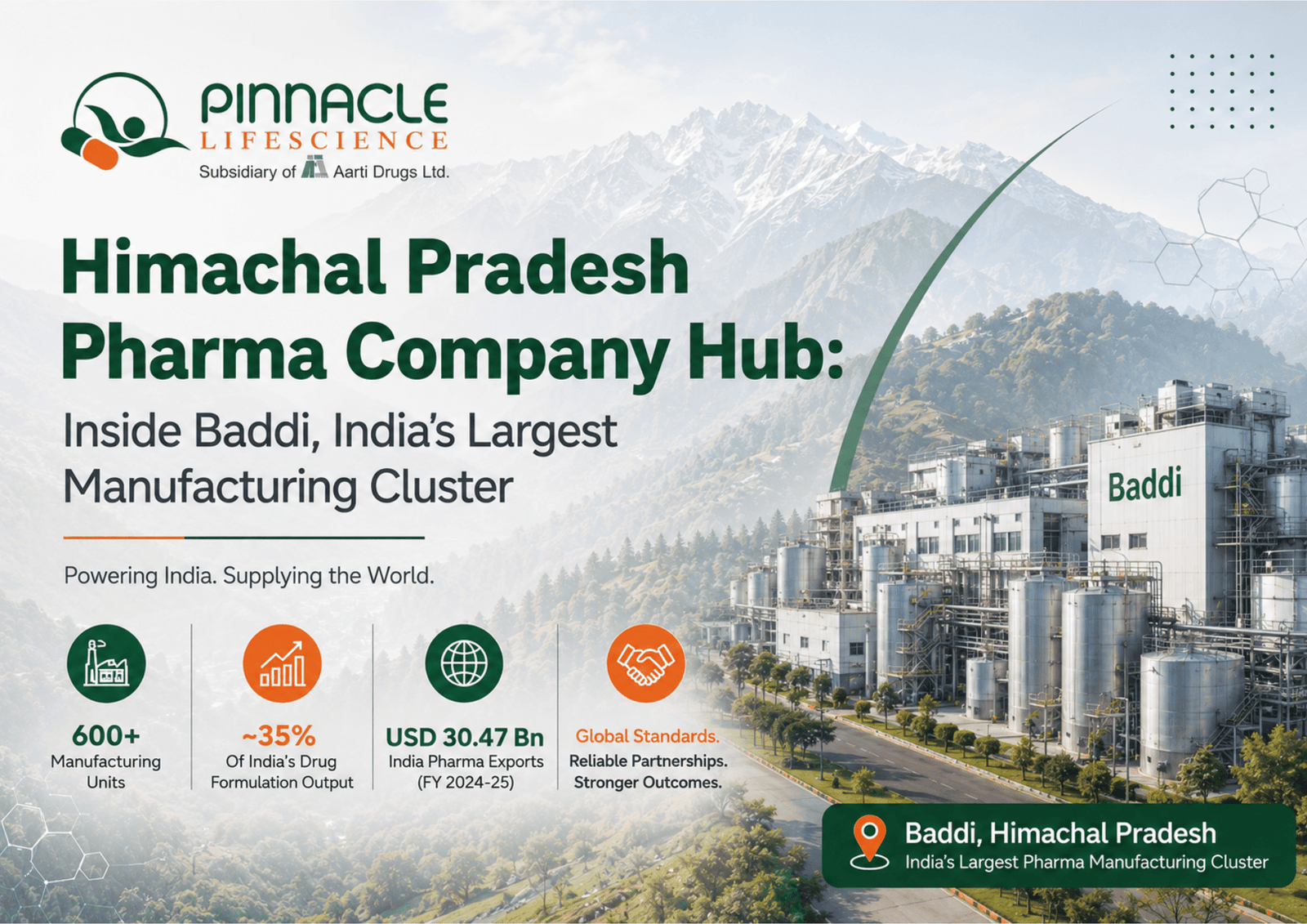
If you’re searching for a Himachal Pradesh pharma company, chances are your search keeps leading back to one place: Baddi, in Solan district. This small industrial belt produces close to a third of every tablet, capsule, and injectable made in India. This piece breaks down why that happened, how the Baddi cluster stacks up against India’s other pharma hubs, and what it actually means if you are a sponsor evaluating a manufacturing partner based here.
The Numbers Behind Baddi’s Scale
Industry estimates consistently put Himachal Pradesh’s share of India’s total drug formulation output at roughly 35 percent, with the Baddi-Barotiwala-Nalagarh belt hosting somewhere between 600 and 1,000-plus active manufacturing units. For context on the wider industry these units feed into, India’s pharmaceutical exports touched approximately USD 30.47 billion in FY 2024-25, and the India CDMO market is valued at around USD 23.3 billion in 2026.
Put simply: one small industrial belt, roughly 35 kilometres from Chandigarh, does more pharma manufacturing volume than most entire countries.
Why Baddi, Specifically
Three things converged to make this happen, and understanding them tells you a lot about what to expect from a facility based here.
Tax and policy incentives came first. Himachal Pradesh’s industrial policy in the early 2000s offered excise and income tax benefits to manufacturers who set up here, which pulled in initial investment from both large pharma majors and smaller contract manufacturers.
Geography did the rest of the work. Baddi sits close to Chandigarh, Delhi NCR, and Punjab, which keeps logistics and distribution costs down for a landlocked hill state. Reliable power and water supply, both non-negotiable for pharmaceutical manufacturing, are also easier to secure here than in many other industrial belts.
Density created its own advantage. Once a critical mass of manufacturers set up in one belt, it became the natural home for the raw material suppliers, packaging vendors, testing labs, and skilled technical workforce that a pharma cluster needs to function efficiently. That density is now self-reinforcing, which is a large part of why Baddi has stayed ahead of newer industrial zones rather than losing ground to them.
Baddi vs. India’s Other Pharma Clusters
Sponsors evaluating manufacturing locations in India are usually choosing between three or four established belts. Here is how they compare on the factors that actually affect a sourcing decision.
| Factor | Baddi, Himachal Pradesh | Hyderabad, Telangana | Ahmedabad/Vadodara, Gujarat |
|---|---|---|---|
| Primary strength | Formulations, generics, contract manufacturing at scale | Biologics, API, CRO/CDMO hybrids | Long-standing API and bulk drug manufacturing |
| Manufacturing density | 600–1,000+ units in a compact belt | Fewer, larger integrated campuses | Distributed across multiple industrial estates |
| Logistics advantage | Proximity to Delhi NCR, Chandigarh, Punjab | Strong air/sea export links via Hyderabad | Port access via Gujarat coastline |
| Best fit for | High-volume solid dosage, oral oncology formulations | Biologics, discovery-to-commercial CDMO work | API and intermediate sourcing |
None of these clusters is objectively “better.” The right one depends entirely on what stage your programme is in and what you’re manufacturing. A sponsor sourcing high-volume oral oncology formulations has different priorities than one sourcing a novel biologic.
A Framework for Evaluating Any Pharma Manufacturing Hub
Location alone should never be the deciding factor in a CDMO decision, but it is a useful first filter. Here is a simple three-factor way to think about it:
1. Regulatory density — How many facilities in this cluster hold USFDA, EU-GMP, or WHO-GMP approval? A dense regulatory footprint usually means the local ecosystem of auditors, consultants, and compliance talent is mature too.
2. Logistics reality — How far is the nearest international airport or port, and how does that affect your cold chain or lead times for the markets you’re shipping to?
3. Ecosystem depth — Are there enough allied vendors nearby (packaging, testing labs, raw material suppliers) that a delay at one supplier doesn’t stall your entire batch?
Baddi scores strongly on all three for solid-dosage oncology work specifically, which is one reason global sponsors continue to source from here even as other belts expand.
How to Evaluate a Baddi-Based Manufacturing Partner: 4 Steps
- Confirm the facility, not just the address. “Based in Baddi” can mean a 50,000 sq. ft. GMP facility or a small job-work unit. Ask for the specific plant location, built-up area, and current regulatory approvals before anything else.
- Check which regulatory bodies have inspected the site. USFDA, EU-GMP, WHO-GMP, and MHRA approvals each open different export markets. Confirm which ones apply to the specific unit you’d be working with, not the parent company’s other plants.
- Ask about containment and dosage-form specialisation. Baddi has manufacturers across tablets, capsules, injectables, and softgels. If your molecule needs high-potency containment (common in oncology), confirm the specific certification for that, not general GMP status.
- Visit before you sign. This holds true regardless of location, but it matters especially in a dense cluster like Baddi, where facility quality varies significantly between neighbouring units.
Frequently Asked Questions
Is Himachal Pradesh a major pharma manufacturing state in India?
Yes. Himachal Pradesh, primarily through the Baddi-Barotiwala-Nalagarh industrial belt, accounts for an estimated 35 percent of India’s total drug formulation output, making it one of the country’s largest pharma manufacturing regions by volume.
How many pharma companies are located in Baddi?
Industry estimates put the number of active pharmaceutical manufacturing units in the Baddi-Barotiwala-Nalagarh belt at somewhere between 600 and over 1,000, ranging from large integrated pharma companies to smaller contract manufacturing units.
Why did pharma companies choose Baddi over other Indian states?
A combination of early tax incentives, proximity to Delhi NCR and Chandigarh for logistics, reliable power and water infrastructure, and the resulting density of skilled workforce and allied vendors made Baddi one of India’s most cost-efficient locations for pharma manufacturing.
What kind of pharma manufacturing is Baddi best known for?
Baddi is primarily known for solid dosage formulations (tablets, capsules) and contract manufacturing at scale, alongside a growing base of injectable and softgel manufacturing capacity.
Is a Baddi-based facility suitable for oncology manufacturing?
It depends entirely on the specific facility, not the location. Oncology manufacturing, particularly for high-potency APIs, requires dedicated containment certification (such as OEB Level-5) that not every unit in the cluster holds. Always verify facility-specific certifications rather than assuming location implies capability.
