

Most people assume the company on a medicine box also made the pills inside it. Often, that’s not the case. Many of the world’s medicines are made by another firm, under contract. This is called pharmaceutical contract manufacturing, and it has a big say in how fast new drugs reach patients.
Maybe you run a pharma brand or a startup with a new formula. Maybe you’re just curious how the industry works. Either way, this guide covers the basics: what contract manufacturing is, how a CMO differs from a CDMO, what the process looks like, and how to pick a partner you can trust.
What Is Pharmaceutical Contract Manufacturing?
Pharmaceutical contract manufacturing is when a drug company hires an outside firm to make its medicines. The drug company owns the product. The contract partner produces it.
Think of a restaurant that hands its recipe to a trusted central kitchen. The recipe stays the same, and so does the brand. Only the place where the cooking happens changes.
The outside firm might make only the active ingredient, or only the finished tablet or injection. It might also handle the whole product, from raw material to packed carton. Some partners also help develop the formula in the first place.
So why would a company give up control of production? Because building a plant is slow and costly. A new facility can take years to build, staff, and get approved, and the patent clock keeps ticking the whole time. A partner who already has the equipment, the people, and the approvals lets a company move faster and spend less up front.
CMO vs CDMO: What’s the Difference?
You’ll see these two terms everywhere, so let’s sort them out.
A CMO (contract manufacturing organization) makes a drug from a formula the client already has. The client says what it needs, and the CMO produces it at scale.
A CDMO (contract development and manufacturing organization) goes further and helps build the product too. That can mean working out the formula and testing it. It can also mean scaling it from small lab batches to full production, then making it for the market.
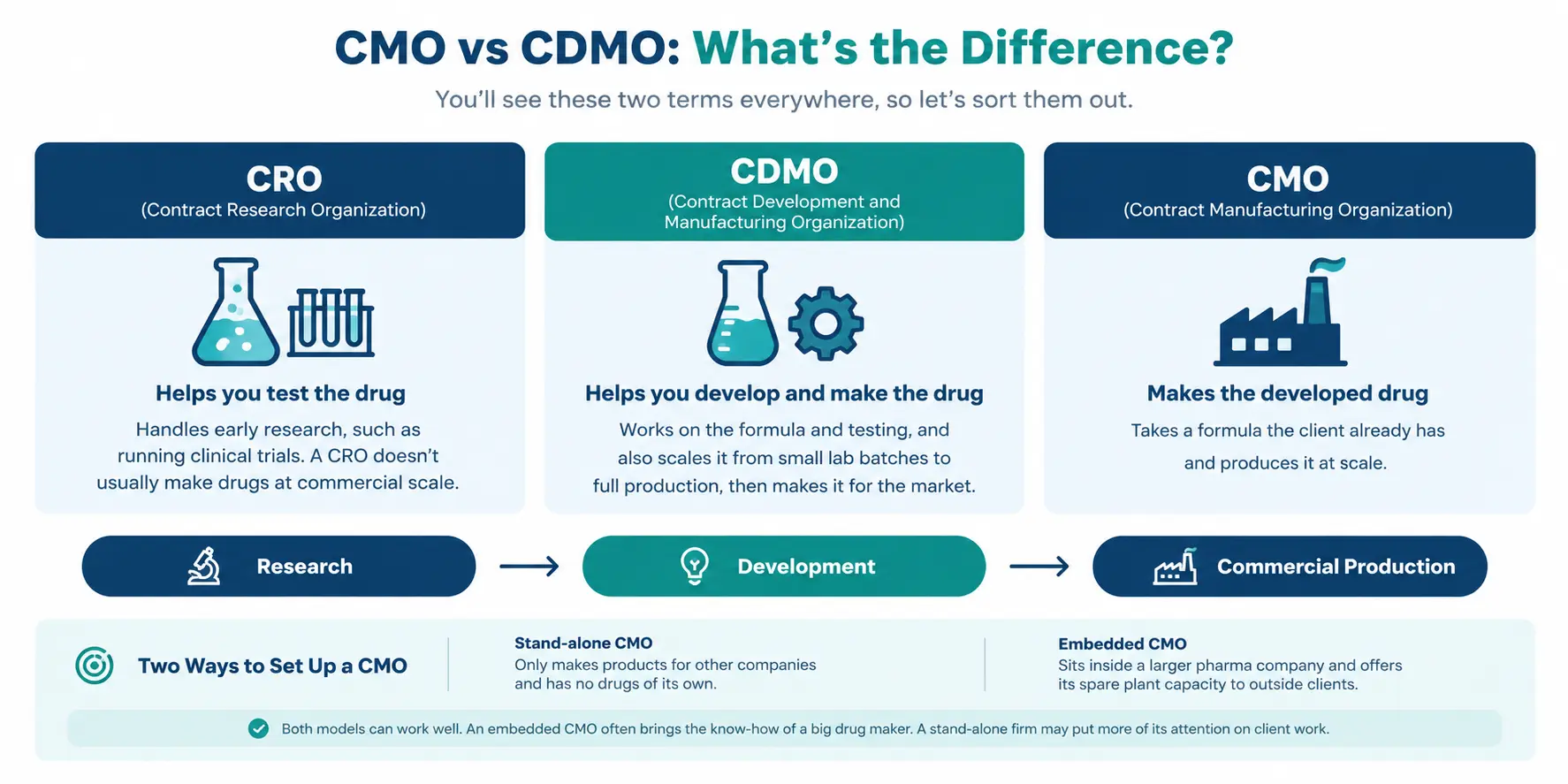 There’s a third term worth knowing. A CRO (contract research organization) handles early research, such as running clinical trials. A CRO doesn’t usually make drugs at commercial scale.
Here’s an easy way to keep them straight:
- CRO: helps you test the drug
- CDMO: helps you develop and make the drug
- CMO: makes a drug you’ve already developed
CMOs can also be set up in two ways. A stand-alone CMO only makes products for other companies and has no drugs of its own. An embedded CMO sits inside a larger pharma company and offers its spare plant capacity to outside clients. Both models can work well. An embedded CMO often brings the know-how of a big drug maker. A stand-alone firm may put more of its attention on client work.
Why Companies Choose Contract Manufacturing
The reasons usually come down to money, speed, and skill.
Lower costs. You skip the huge expense of building and running your own plant. You also avoid paying to upgrade equipment every time rules or technology change.
Faster time to market. A partner with an approved site can start sooner. Every month saved counts when a patent has a fixed life.
Room to grow. Demand can jump after launch. A good partner can raise output without you buying new machines.
Specialist skills. Some products are hard to make, such as high-potency drugs, sterile injectables, and biologics. Firms that focus on these already have the trained staff and safety systems in place.
Focus on your strengths. Many drug companies would rather spend their time on research, sales, and building their brand. Handing off production frees them to do that.
It isn’t all upside, though. You give up some direct control. If your partner has a quality problem or a supply delay, your product feels it too. That’s why choosing the right partner matters so much.
How the Process Works, Step by Step
Every project is a little different, but most follow a similar path.
- Agreement. Both sides sign a contract covering scope, timelines, price, and who handles what. A separate quality agreement sets out each side’s quality and compliance duties. Regulators expect to see this document.
- Technology transfer. The client shares everything needed to make the product, including the formula, raw material specs, test methods, and process details. The partner then runs trial batches to prove it can make the product the same way every time.
- Production. Now the real work starts. For a coated tablet, this usually means blending the active and inactive ingredients and pressing the tablets. Then a coating is added to help with taste, stability, or ease of swallowing.
- Quality control. Each batch is tested before release. If a batch doesn’t meet the agreed specs, it doesn’t ship.
- Packaging and serialization. Products are packed and labeled. In the US, each saleable unit also gets a unique serial number, so it can be traced through the supply chain. The Drug Supply Chain Security Act requires this.
- Delivery. Finished goods go to the client or straight into their distribution network.
The Rules Contract Manufacturers Must Follow
Making medicine is one of the most closely watched jobs in any industry. Contract manufacturers must follow Good Manufacturing Practice (GMP) rules. In the US, the FDA calls these current Good Manufacturing Practice, or cGMP.
These rules cover almost everything: how equipment is cleaned and calibrated, how staff are trained, how records are kept, and how problems are looked into.
Regulators inspect contract sites just as they inspect brand-owned plants. If a partner makes drugs for sale in the US, Europe, or elsewhere, the regulators in those markets can audit it. Clients usually run their own audits as well.
In India, manufacturers must also meet the revised Schedule M standards. These bring local rules closer to global GMP norms.
Why India Matters in Contract Manufacturing
India has become a major hub for pharmaceutical contract manufacturing companies, for a few clear reasons.
Costs are lower than in many Western markets, often with no drop in quality. The country has a large pool of trained chemists, pharmacists, and engineers. Many Indian plants hold US FDA approvals and meet WHO-GMP standards. India also makes a big share of the world’s generic medicines, so local suppliers of raw materials and packaging are well established.
For global brands, that mix of price, skill, and approvals puts India high on the shortlist.
How to Choose the Right Partner
This is where many projects succeed or fail. Here’s what to check.
Track record. Ask what products they’ve made and for whom. Look for experience with your type of product, whether that’s tablets, creams, or injectables.
Regulatory history. Check past inspection results and any warning letters. A clean record with the regulators in your target market is a must.
Quality systems. Ask how they handle errors, complaints, and failed batches. Visit the site if you can.
Capacity. Make sure they can handle your launch volume and your growth plans.
Communication. You want a partner who flags problems early, not after a missed shipment.
Special handling. If your product is high-potency, a controlled substance, or sterile, confirm they have the right setup.
Take your time with this choice. Switching partners later is slow and costly, because the new site has to go through tech transfer and approvals all over again.
What’s Next for the Industry
Demand for medicine keeps rising, and more companies are outsourcing to keep up. Automation, better data tools, and AI are helping plants run more smoothly and catch quality issues sooner. Complex products like biologics and antibody-drug conjugates are also pushing contract firms to build new skills.
For drug companies, the message is simple. You don’t need to own a factory to bring a great medicine to market. You need the right partner.
