
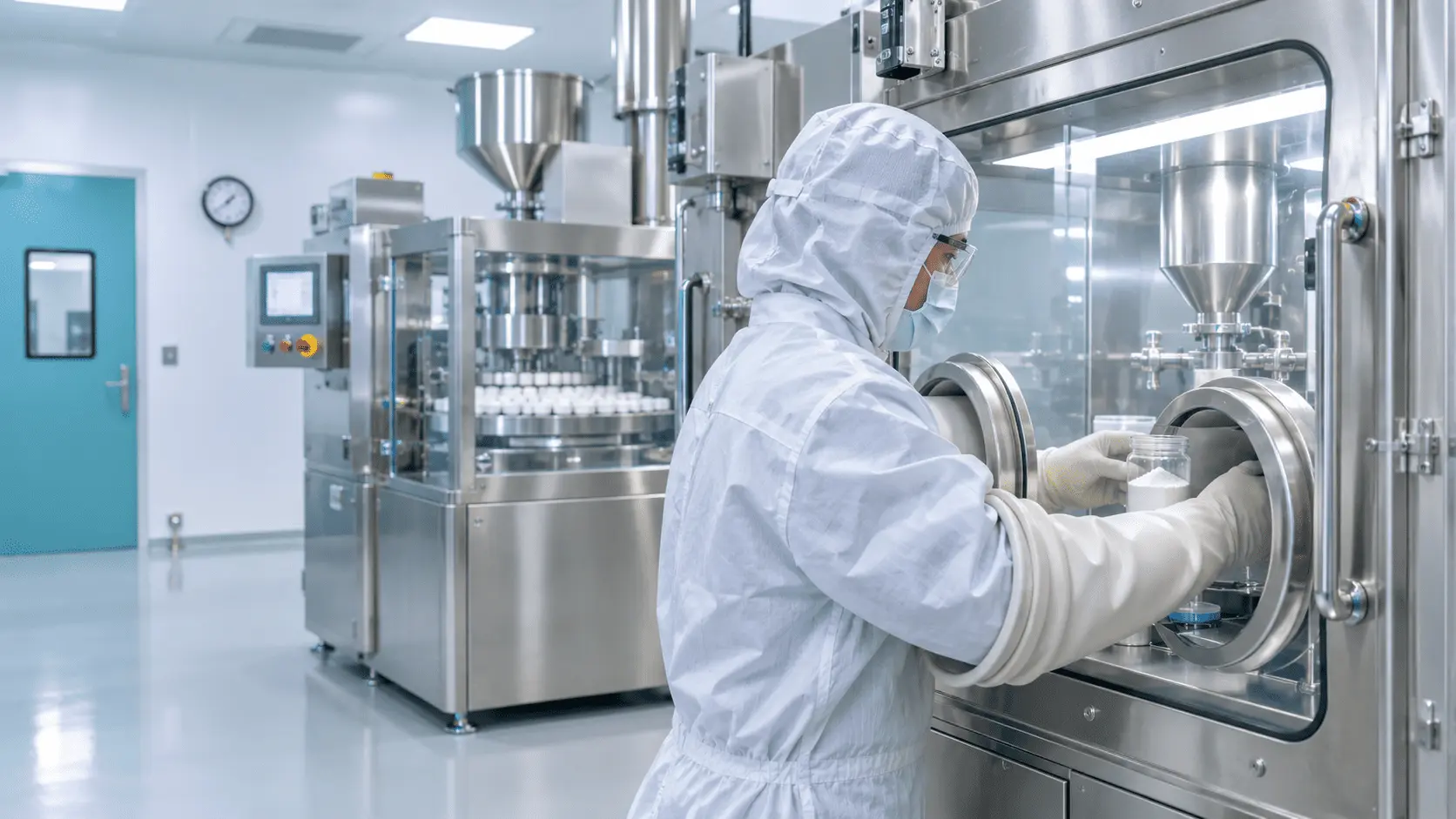
High-potency oncology drug manufacturing requires specialised facilities, controlled material handling and validated processes to protect product quality and operator safety. Many oral oncology medicines contain highly potent active pharmaceutical ingredients (HPAPIs). Unlike conventional manufacturing, they need strict containment at every stage where the hazardous material is handled.
For oral solid dosage forms such as tablets and capsules, the oncology pharmaceutical manufacturing process typically runs from API receipt and dispensing through blending or granulation, compression or capsule filling, film coating and primary packaging. Each stage needs specific controls to minimise occupational exposure, prevent cross-contamination and keep the dose uniform.
Quick answer: High-potency oncology drug manufacturing is the controlled production of cancer medicines containing highly potent active ingredients. It combines specialised containment systems, precise formulation processes, in-process quality checks and validated cleaning procedures to manufacture safe, consistent oral dosage forms.
This guide explains each manufacturing stage, its risks, and the infrastructure pharmaceutical companies should evaluate when selecting an oncology manufacturing partner. It is published by Pinnacle Life Science Pvt. Ltd, an oncology-focused CDMO and wholly owned subsidiary of Aarti Drugs Limited. Pinnacle manufactures oncology oral solid dosage forms at its facility in Baddi, Himachal Pradesh.
High-potency oncology drug manufacturing process
- API receipt and material handling: inspection, quarantine and quality release
- Contained API dispensing: precise weighing and controlled transfer
- Granulation and blending: direct compression, dry granulation or wet granulation
- Tablet compression or capsule filling: forming the oral dosage form
- Film coating: controlled coating and product protection
- Primary packaging: blister or bottle filling and sealing
- Finished-product testing and release: testing, batch record review and QA release
Illustrative process flow. Tablet compression and capsule filling are alternative operations, depending on the dosage form, not consecutive stages.
What Is High-Potency Oncology Drug Manufacturing?
High-potency oncology drug manufacturing is the production of cancer medicines made from HPAPIs, which are compounds that can cause harm at very low exposure. There is no single regulatory definition of an HPAPI. Many companies use an occupational exposure limit at or below 10 µg/m³ as a working threshold, but each organisation sets its own.
NIOSH publishes a list of drugs it considers hazardous, and many antineoplastic agents appear on it. See the NIOSH List of Hazardous Drugs in Healthcare Settings, 2024. cdc
This guide covers oral solid dosage (OSD) manufacturing: tablets and capsules taken by mouth, the format used for many kinase inhibitors and other targeted oncology therapies.
Understanding OEL and OEB Levels in Oncology Manufacturing
Two terms decide how a potent compound is handled.
- An Occupational Exposure Limit (OEL) is the maximum airborne concentration of a specific compound that workers may be exposed to over a shift. It is derived from that compound’s toxicology.
- An Occupational Exposure Band (OEB) is a category that groups compounds with similar OELs and links each group to a containment strategy.
| Parameter | OEL | OEB |
|---|---|---|
| Meaning | Occupational Exposure Limit | Occupational Exposure Band |
| Purpose | Defines an exposure limit | Groups compounds by potency and exposure risk |
| Application | Workplace exposure control | Choosing a containment strategy |
| Assessment | Compound-specific | Based on an assigned banding framework |
OEB ranges are not set by regulators and differ between company and industry frameworks. Compounds in the highest bands, usually OEB 4 and OEB 5, need engineered containment such as isolators, because protective equipment alone cannot reliably keep exposure low enough.
A facility’s claimed band is only as good as its evidence. Manufacturers should ask for an independent containment assessment that states which process steps were tested, when and against what limit. Our guide to OEB Level-5 containment in oncology manufacturing explains the bands in detail.
How Does the Oncology Drug Manufacturing Process Work?
1. API receipt and material handling
Oncology API handling starts before any container is opened. Under US cGMP, each lot of incoming material must be held from use until it has been sampled, tested or examined and released by the quality control unit. See 21 CFR 211.84. ecfr
For a potent API, receipt adds further controls:
- Containers are inspected for damage and decontaminated externally before entering the facility
- Sampling takes place inside a sampling isolator or contained booth, not on an open bench
- The API is stored in a segregated, access-controlled area until released
- Material quantities are reconciled against batch records, so losses are detected and investigated
2. Contained API dispensing
Dispensing is the first point at which pure API is exposed, so it is one of the highest-risk steps. Quantities are often small, which makes containment and weighing accuracy equally important.
- Balances sit inside the isolator and are qualified for the smallest quantity they will weigh
- Dispensed API leaves the isolator through a closed transfer system, such as a split butterfly valve or continuous liner
- For very low-dose products, the API is often pre-blended with part of the excipients (geometric dilution) before the main blend
3. Granulation and blending
This stage decides whether every tablet carries the same dose. Each of the three common routes carries different risks.
- Direct compression: fewest steps and least handling, but low-dose blends can segregate, leaving some units above or below strength.
- Dry granulation (roller compaction): avoids water and heat but generates fine dust, so the compactor and mill must be enclosed.
- Wet granulation: binding the API into granules improves uniformity and reduces free dust later. The granulator, dryer and drying exhaust system all need appropriately validated containment, because process air passes through potent material.
Blend uniformity is confirmed by sampling at several points in the blender, and with potent products that sampling also happens inside containment.
4. Tablet compression or capsule filling
Compression. The tablet press forms granules into tablets at high speed, and punch movement can release dust. Presses for potent products are enclosed and often designed for washing in place. In-process checks include tablet weight, thickness and hardness, plus friability and disintegration tests, which themselves generate dust and must be carried out inside containment. Dedusters and metal detectors are typically docked directly to the press, and tooling changes are handled under controlled conditions.
Capsule filling. For oncology capsule manufacturing, an enclosed encapsulator doses powder or granules into each shell, with fill weight checked throughout the run. Depending on the process, filled capsules may pass through a polisher or deduster to remove powder from the shell exterior.
5. Film coating
Film coating protects the product from moisture and light, masks taste and gives each strength a distinct colour. For potent products, coating may also reduce API residue on the tablet surface. It does not eliminate the hazard or replace containment.
Coating runs in an enclosed perforated pan with filtered exhaust, and weight gain is monitored to confirm a complete coat. Many oral cytotoxic products are labelled to be swallowed whole.
6. Primary packaging
Tablets and capsules are exposed for the last time when they are fed into blister or bottle lines, so the line stays within containment until each pack is sealed.
Sealed packs are typically wipe-tested to confirm the exterior is free of residue. Secondary packaging can then move to a less restrictive area, subject to validated decontamination steps and site-specific procedures. Labels carry the hazard warnings required in each market.
Stage summary
| Stage | Main exposure risk | Main product-quality risk | Typical in-process check |
|---|---|---|---|
| API receipt | Damaged containers, sampling | Wrong or degraded material | Identity test, quarantine release |
| Dispensing | Open pure API | Weighing error | Balance check, dual verification |
| Granulation and blending | Dust during charging and drying | Poor uniformity, segregation | Blend uniformity sampling |
| Compression | Punch dust, tooling changes | Weight and hardness variation | Weight, thickness, hardness, friability |
| Capsule filling | Powder dosing, shell exteriors | Fill weight variation | Fill weight checks |
| Film coating | Pan loading, exhaust air | Incomplete coat | Weight gain |
| Primary packaging | Exposed units at feed | Seal integrity, mix-ups | Seal checks, external wipe test |
Developing an oral oncology product? See Pinnacle’s oncology manufacturing infrastructure in Baddi.
What Equipment Is Used in HPAPI Manufacturing?
HPAPI manufacturing uses conventional process equipment that is enclosed, docked to containment or designed for contained operation.
| Stage | Typical equipment |
|---|---|
| Receipt and dispensing | Sampling and dispensing isolators, closed transfer valves or liners |
| Granulation and blending | Contained high-shear granulators, fluid bed dryers or roller compactors, blenders |
| Compression and filling | Enclosed tablet presses, encapsulators, dedusters, metal detectors |
| Coating | Enclosed perforated coating pans with filtered exhaust |
| Packaging | Contained blister or bottle lines up to the sealing point |
| Supporting systems | Dedicated HVAC, negative-pressure suites, wash-in-place systems |
The specifications and test evidence for each item are covered in our HPAPI manufacturing equipment checklist.
How Is Cross-Contamination Prevented During Oncology Drug Manufacturing?
Preventing cross-contamination protects every patient who takes any product made in the same facility. EU GMP requires premises and equipment to be designed for effective cleaning and the avoidance of cross-contamination. See EU GMP Chapter 3. europa
In practice, high potency pharmaceutical manufacturing relies on eight controls working together:
- Dedicated or segregated areas: potent products run in a dedicated suite, or in shared areas justified by a documented risk assessment.
- Negative-pressure containment: isolators and suites are held at lower pressure than surrounding areas, so air flows inward.
- Closed material transfer: valves, ports and liners move material without opening it to the room.
- Validated equipment cleaning: cleaning procedures are proven to remove residue to a defined limit.
- HBEL-based cleaning limits: limits are set from each compound’s health-based exposure limit (see below).
- Personnel gowning and de-gowning: controlled change rooms stop residue leaving on clothing.
- Environmental monitoring: surface wipes and air sampling confirm that controls are working.
- Waste handling and decontamination: sealed waste routes ensure cleaning does not create a new exposure path.
What Quality Tests Are Performed on Finished Oncology Tablets and Capsules?
Manufacturing does not end at packaging. Each batch is tested and released before it is shipped. Typical finished-product tests include:
- Identification and assay: confirms the correct API at the correct strength
- Uniformity of dosage units / content uniformity: confirms each unit carries the right dose, which is critical for low-dose potent products
- Dissolution: confirms the API is released as intended
- Related substances and degradation products: measures impurities
- Microbial limits: where the specification requires them
- Packaging integrity: confirms seals protect the product
- Stability testing: confirms the product stays within specification across its shelf life
The exact tests depend on the product, dosage form, pharmacopoeial specifications and the approved regulatory filing. QA then reviews the full batch record, including all in-process results and deviations, before release.
What Are the GMP Requirements for Oncology Manufacturing?
Oncology products follow the same GMP framework as other medicines, with added expectations for potent compounds:
- United States: 21 CFR Part 211 sets cGMP requirements for finished pharmaceuticals.
- European Union: EU GMP Chapters 3 and 5 cover premises, equipment and the prevention of cross-contamination. The EMA’s guideline recommends deriving a scientifically based threshold for each active substance, which can also justify carry-over limits in cleaning validation. See the EMA guideline on health-based exposure limits. europa
- India: the Union health ministry notified the revised Schedule M on 28 December 2023, aligning India’s GMP requirements more closely with WHO standards. pharmafocusasia
One distinction matters throughout. An OEL protects workers, while a health-based exposure limit (HBEL), often expressed as a permitted daily exposure (PDE), protects patients. Cleaning limits must be based on the HBEL.
What Are the Challenges in Scaling Up Oncology Manufacturing?
- Uniformity at larger scale: a blend that is uniform in a small blender may behave differently in a larger one, so blending time and sampling plans need re-establishing.
- Containment changes with equipment: containment results from one equipment train do not automatically apply to a larger one. New equipment and transfer points need their own assessment.
- Cleaning revalidation: larger equipment has more surface area, which changes the carry-over calculation.
- Small commercial volumes: many oncology products sell in modest quantities, so flexible batch sizes matter more than maximum throughput.
These are managed through structured technology transfer, covered in our guide to the oncology drug development process.
How Should You Evaluate a High-Potency Manufacturing Facility?
- Which process steps run inside isolators, and which do not?
- Which granulation routes are available within containment?
- Where are blend uniformity samples and in-process tests taken?
- How are cleaning limits derived, and from which HBEL?
- What batch sizes are available for your dosage form?
- Where does containment end on the packaging line?
- Does containment test data cover transfer points as well as isolators?
- Can your QA and EHS teams audit the line before contracting?
For the full partner framework, see our guide to selecting an oncology CDMO in India. For containment due diligence, read choosing a CDMO for OEB 4 and OEB 5 compounds.
How Does Pinnacle Life Science Manufacture High-Potency Oncology Oral Solids?
Pinnacle Life Science Pvt. Ltd manufactures oncology oral solid dosage forms at its formulations facility in Baddi, Himachal Pradesh. The table separates company-stated capabilities from public regulatory records.
| Area | Detail | Basis |
|---|---|---|
| Contained process steps | API dispensing, granulation, tablet compression, film coating and primary packaging take place within isolator systems | Pinnacle facility information |
| Containment level | The oncology unit is designed to handle compounds at OEB Level 5 | Pinnacle facility information |
| Dosage forms | Tablets, capsules and oncology oral solid dosage forms (product range) | Pinnacle facility information |
| API supply | As a wholly owned subsidiary of Aarti Drugs Ltd, Pinnacle has access to the group’s API manufacturing capabilities for relevant molecules, supporting supply chain coordination and traceability | Pinnacle facility information |
| US FDA inspection, April 2024 | The inspection ended with five Form 483 observations, none relating to data integrity. The FDA later issued an Establishment Inspection Report recording the inspection as closed. | Aarti Drugs regulatory disclosure |
| US FDA inspection, November 2026 | An inspection from 2–6 November 2026 ended with three Form 483 observations, none relating to data integrity. The company has stated it will work with the FDA to address them. | Aarti Drugs regulatory disclosure Aarti Drugs Baddi facility gets 5 USFDA observations +2 |
A Form 483 lists inspectors’ observations at the end of an inspection and is not a final FDA determination. An EIR records the outcome of an inspection; neither document is an approval of the facility. Aarti Drugs’ disclosures are published on its shareholder notices page.
Pinnacle welcomes QA and EHS audits during due diligence. Explore Pinnacle’s quality systems to learn more.
Conclusion
High-potency oncology drug manufacturing succeeds or fails at the level of individual steps. Contained receipt and dispensing, a granulation route chosen for uniformity, enclosed compression and coating, and a packaging line that stays contained until sealing all have to work together. Behind them sit HBEL-based cleaning limits, sensitive analytical methods and full finished-product testing. A manufacturing partner should be able to show evidence for each, stage by stage.
Ready to discuss your oncology product? Contact Pinnacle Life Science to talk to our technical team about formulation, technology transfer or commercial manufacturing.
Frequently Asked Questions
What is the difference between conventional and high-potency oncology drug manufacturing?
Both follow GMP. High-potency manufacturing adds occupational exposure controls, engineered containment and stricter cross-contamination prevention, because the active ingredient can harm people at very low exposure.
Can high-potency oncology drugs be manufactured as tablets and capsules?
Yes. Many oncology medicines are oral solid dosage forms. The right format and process depend on the active ingredient, dose, stability and product requirements.
What is an HPAPI?
An HPAPI is a highly potent active pharmaceutical ingredient that can cause harm at very low exposure. Many companies use an OEL at or below 10 µg/m³ as a working threshold, though definitions vary.
Why is wet granulation often used for potent, low-dose oncology drugs?
Binding the API into granules improves content uniformity and reduces free dust in later steps. The granulator, dryer and exhaust system still need validated containment.
Does film coating make a cytotoxic tablet safe to handle?
No. Coating may reduce API residue on the tablet surface, but it does not eliminate the hazard or replace containment.
What is the difference between an OEL and a PDE?
An OEL limits how much compound workers may be exposed to in air. A PDE limits how much of one product may safely carry over into another. Cleaning limits are based on the PDE.
Why is negative-pressure containment important in oncology manufacturing?
It keeps air flowing inward, so hazardous powder does not escape into surrounding areas. It works alongside isolator integrity, closed transfers, HVAC filtration and operating procedures.
How is content uniformity assured for low-dose oncology tablets?
Through accurate dispensing, pre-blending of the API, a suitable granulation route, blend uniformity sampling and content uniformity testing on finished units.
