
Last updated: October 2026
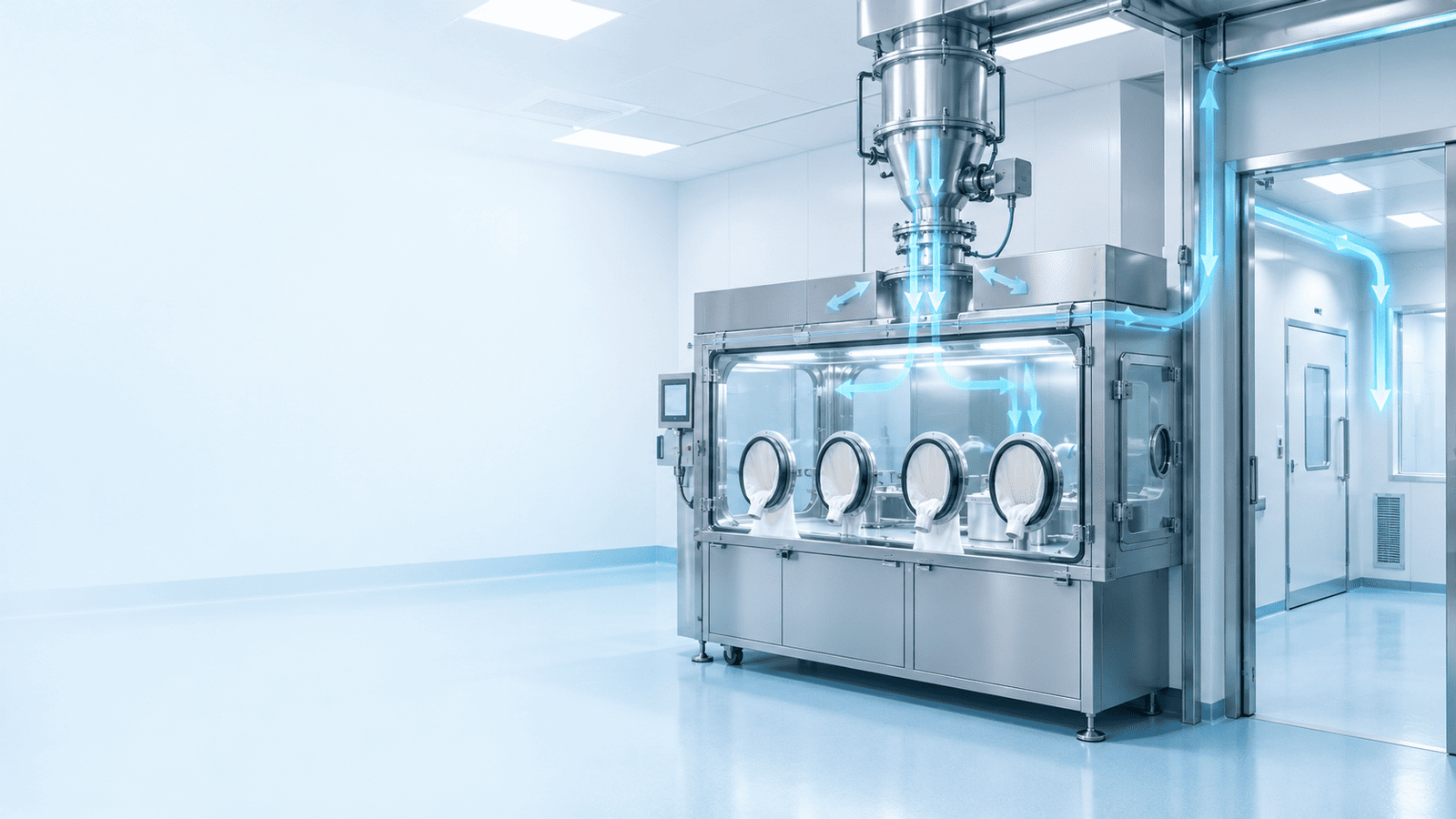
A suite built for sub-microgram OELs isn’t a list of gadgets. It’s a system: isolators and closed transfer to keep powder inside, dedicated air handling to keep anything that escapes from travelling, cleaning and waste routes that don’t undo the good work, and monitoring that proves it all keeps working. Miss one piece and the others can’t make up for it.
This guide is the equipment-level view. If you want to understand what the bands mean first, read our guide to OEB Level-5 containment in oncology manufacturing. If you’re choosing a partner, start with how to choose a CDMO for OEB 4 and OEB 5 compounds. Here we go piece by piece through what a suite needs and what evidence shows it works.
Start With Your Number, Not the Equipment
Before looking at any hardware, get clear on the exposure limit you’re designing against. Unit confusion causes more trouble here than you’d expect.
One milligram is 1,000 micrograms, and one microgram is 1,000 nanograms. So an OEL of 1 ng/m³ is 1,000 times lower than the 1 µg/m³ line that separates OEB 4 from OEB 5. Plenty of ADC payloads and other ultra-potent compounds sit down in that nanogram range.
That matters because a containment benchmark isn’t automatically enough for every compound. A result of 100 ng/m³ on a surrogate test shows strong performance, but it sits well above a 1 ng/m³ limit. When a CDMO quotes a containment figure, ask for it in the same units as your OEL, along with the task duration, so the two can actually be compared. A qualified industrial hygienist can help translate short test tasks into an 8-hour exposure picture.
The Equipment Checklist
1. Primary Containment: Isolators
For open-powder work at these levels, rigid-wall isolators are the normal starting point. Look for:
- Negative pressure inside the isolator, with continuous monitoring and alarms
- HEPA-filtered exhaust, with a safe filter change method
- Glove and sleeve integrity testing, with records
- Leak testing at commissioning and at defined intervals
- Interlocks so doors and transfer ports can’t open in unsafe states
- A way to decontaminate or wash down the interior between campaigns
Glove ports are the part people forget. Gloves wear, tear and get replaced, and each change is a moment where the barrier is briefly compromised. Ask how it’s done.
2. Material Transfer
Moving powder in and out is often the hardest point to control, because every connection is a potential release. Common closed-transfer options include:
- Split butterfly valves (SBV)
- Rapid transfer ports (RTP)
- Continuous liner or bag-in/bag-out systems
- Closed charging and vacuum transfer for powders
Ask which transfer method is used at every step, and whether the containment test data covers transfers as well as the isolator itself. A great isolator with an open charge point isn’t a great system.
3. Process Equipment That Fits the Containment
Your tablet press, granulator, blender and mill have to work inside, or be docked to, the containment. Check that:
- Equipment is designed for contained operation, not retrofitted
- Surfaces are smooth with minimal crevices, so they can be cleaned thoroughly
- Tooling handling and changeovers are contained or controlled
- Washing in place is possible where the process allows it
4. Dedicated Air Handling
The air system is your backup layer when primary containment is breached, so it has to be independent and predictable.
- A dedicated air handling unit for the HPAPI area, with no shared supply or exhaust circuits
- A pressure cascade holding the suite at least 12.5 Pascals negative to adjacent areas
- Interlocked airlocks at every entry and exit
- HEPA-filtered supply and double-HEPA exhaust, with in-bag filter change
- Regular HEPA integrity testing
- Continuous pressure monitoring with alarms and a clear response if the cascade is lost
5. Cleaning, Decontamination and Waste
- Closed-system waste handling, with sealed liners and a controlled route out
- Validated decontamination procedures for equipment, surfaces and tools
- A plan for liquid waste and wash water, so cleaning doesn’t create a new exposure path
- Cleaning validation with swab recovery data and trace-level analytical methods (see our guide to cleaning validation for OEB 5 compounds)
6. Monitoring
- Surrogate testing of isolators at commissioning and after major changes, then at scheduled intervals
- Personal and area air sampling where the risk assessment calls for it
- Pressure differential logging and trending, not just alarms
- Surface wipe sampling around transfer points and exits
Trending is the part that separates a facility that’s actually in control from one that passed a test once. Ask to see the history, not just the latest result.
7. People and Gowning
- Change rooms and gowning flow that stop contamination leaving the suite
- Respiratory protection (PAPR or supplied-air) for any work outside an isolator
- Compound-specific training before first handling
- A medical surveillance and biological monitoring programme
8. Facility Layout and Utilities
- Separate paths for people, materials and waste, so they don’t cross
- Planned shutdown behaviour if power or HVAC fails
- Dedicated or controlled utilities where cross-contamination is a risk
[ADD: 2 to 3 sentences from Pinnacle’s engineering, QA or EHS team on a design choice or lesson from their own containment suite. Real, specific experience goes here.]
What Evidence to Ask For
Every item on the list should come with something you can read.
| Equipment area | Evidence to request |
|---|---|
| Isolators | Latest surrogate test report, glove integrity and leak test records |
| Transfer systems | Test data that includes transfer steps, maintenance records |
| Air handling | Pressure cascade logs, HEPA integrity certificates, alarm history |
| Cleaning | Validation master plan, swab recovery data, analytical method reports |
| Waste | Written waste route and decontamination procedure |
| Monitoring | Sampling plan, trend charts, out-of-limit investigations |
| People | Training records, PPE standards, surveillance programme outline |
For a full list of what to request from a CDMO, use our 4-step verification checklist.
Where Suites Commonly Fall Short
A few weak spots show up again and again in HPAPI facilities:
- Transfer points get less attention than the isolator itself
- Gloves and filters are changed on a schedule no one tracks
- Changeovers between compounds rely on habit instead of a written, tested procedure
- Hard-to-reach surfaces inside equipment aren’t covered by cleaning validation
- Alarms go off often enough that people stop reacting
- Testing happens once at commissioning and then drifts
None of these need new technology to fix. They need discipline and records.
A 10-Minute Floor Walk
If you’re auditing a suite, here’s a quick pass that tells you a lot:
- Watch a transfer in or out. Is it truly closed?
- Check the pressure gauges against the alarm log.
- Ask to see the last glove change record.
- Look at the doffing area and how operators leave.
- Pick one piece of equipment and ask how its hardest-to-reach surface is cleaned and verified.
Our CDMO audit preparation guide goes further.
How Pinnacle Life Science Approaches High-Potency Suites
Our US FDA-approved Baddi facility runs high-potency oncology oral solid dosage work inside isolator systems, from API dispensing through granulation, compression, film coating and primary packaging. Use this checklist on us as well: ask for the evidence and talk to our HPAPI team about your compound.
Frequently Asked Questions
What equipment does an HPAPI suite need for sub-microgram OELs?
Rigid-wall isolators, closed material transfer, containment-compatible process equipment, dedicated HVAC with pressure cascade and HEPA filtration, closed waste handling, validated cleaning, monitoring and appropriate PPE and training.
What containment performance is needed for a 1 ng/m³ OEL?
It depends on the task and its duration, but the demonstrated performance has to sit below the OEL with margin. A 100 ng/m³ benchmark alone does not show protection against a 1 ng/m³ limit, so ask for results in the same units as your OEL and have a qualified industrial hygienist review them.
Are isolators or RABS better for highly potent compounds?
Isolators are generally the preferred primary containment for compounds at this level. Confirm the choice for your compound and process with a containment specialist.
Why is material transfer such a risk?
Because powder moves between zones, and every connection is a possible release point. Closed transfer devices such as split butterfly valves and rapid transfer ports reduce that risk, and test data should cover transfers as well as the isolator.
How often should isolators be tested?
At commissioning, after significant changes and at intervals set in the facility’s validation plan. Ask for the schedule and the latest results, and look at the trend over time.
Reviewing an HPAPI Suite or Planning a Programme?
Tell us about your compound, its exposure limit and your timeline. Contact Pinnacle Life Science.
