
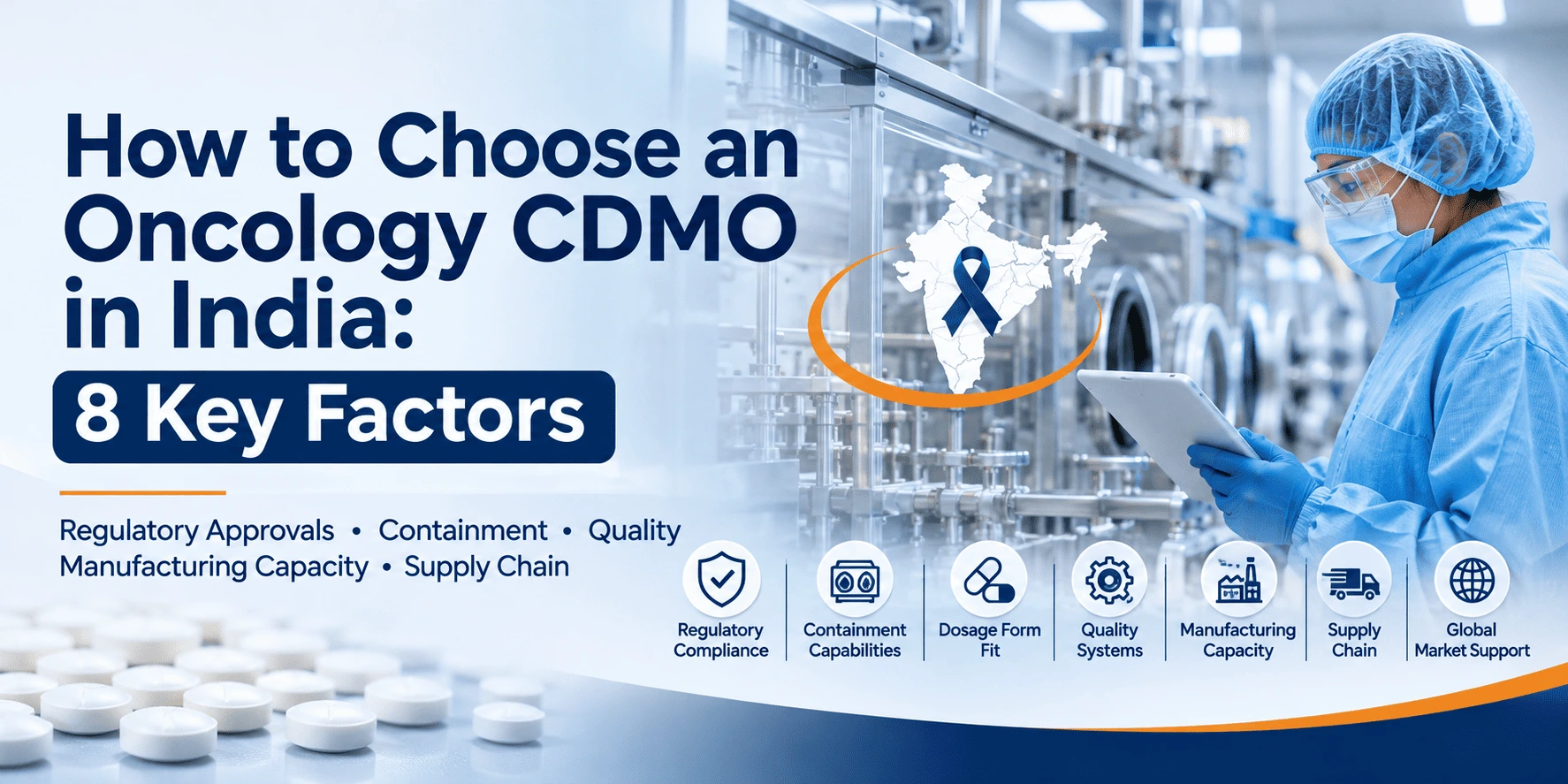
Choosing an oncology CDMO in India is a technical and commercial decision that shapes product quality, filing timelines and supply for years.
Quick answer: An oncology CDMO should be evaluated on its regulatory compliance, containment systems, dosage form capabilities, technology transfer experience, quality management, manufacturing capacity, API supply chain and international regulatory support. Pharmaceutical companies should request documented evidence for each capability before entering a manufacturing agreement.
This guide sets out the evidence to request under each factor and the warning signs to watch for.
What Is an Oncology CDMO?
An oncology CDMO develops and manufactures cancer medicines for other pharmaceutical companies. CDMO stands for Contract Development and Manufacturing Organisation. Oncology contract manufacturing typically covers formulation and analytical development, scale-up, process validation, commercial production, packaging and regulatory documentation. These services support the later stages of the oncology drug development process.
For a wider view of the market, see our guide to CDMO companies in India.
Why Does Oncology Manufacturing Require Specialised Facilities?
Many oncology actives are highly potent active pharmaceutical ingredients (HPAPIs) that can harm healthy cells at very low exposure. High-potency oncology manufacturing must protect operators, prevent cross-contamination between products and control waste and exhaust air.
In practice, that means segregated areas, separate air handling, closed material transfer and cleaning limits set from toxicological data. Our HPAPI suite equipment checklist lists the equipment this requires.
What Are the 8 Factors to Evaluate in an Oncology CDMO?
1. Regulatory approvals
Regulators inspect a specific site and scope, so a company-level claim is not enough. Use each agency’s own terms when you ask:
- US FDA: the agency inspects facilities; it does not issue a general facility approval. Its public Inspection Classification Database records final outcomes as No Action Indicated (NAI), Voluntary Action Indicated (VAI) or Official Action Indicated (OAI). That database is not a complete record of every inspection, so do not rely on it alone. Ask the CDMO for the inspection dates, the classification, any Form 483 observations and the Establishment Inspection Report (EIR). The classification and the EIR are separate records, so request both. fdafda
- EU: a current EU GMP certificate. EU authorities record certificates and non-compliance statements in the public EudraGMDP database, so you can check them yourself. europa
- UK: a current MHRA GMP certificate. UK certificates issued since 2021 sit in the MHRA’s own records, not in EudraGMDP, so verify them with the MHRA.
- India and export markets: the state manufacturing licence covering your product category, plus WHO-GMP certification and a Certificate of Pharmaceutical Product (COPP) where your markets need them.
Confirm that each document covers the oncology block and your dosage form. Useful references are the US FDA Inspection Classification Database, the EudraGMDP register of GMP certificates and EMA’s guidance on good manufacturing practice.
2. Containment capabilities
Two terms are often confused. An Occupational Exposure Limit (OEL) is a specific airborne concentration considered safe for a compound. An Occupational Exposure Band (OEB) is a category that groups compounds by OEL range and links them to a level of containment.
Band cut-offs are not regulatory thresholds and differ between companies. As an illustration only, one commonly used scheme places OEB 4 at 1–10 µg/m³ and OEB 5 below 1 µg/m³. adragos-pharma
Ask three things: whose band definition the CDMO uses, which process steps run inside isolators, and when containment performance was last tested. For the full method, read our guide on how to choose a CDMO for OEB 4 and OEB 5 compounds and our explainer on OEB Level-5 containment in oncology manufacturing.
3. Dosage form capabilities
Match the CDMO’s commercial experience to your product, not to oncology drug manufacturing in general. Check:
- Minimum and maximum batch sizes, since launch volumes for oncology oral solids are often small
- Experience with low-dose strengths, where content uniformity is harder to achieve
- Packaging formats your markets require, such as blister types and bottle packs
- Whether your product would run on dedicated equipment or in campaigns
4. R&D and technology transfer
A sound transfer follows defined stages: gap assessment, analytical method transfer, engineering batch, validation batches and stability studies. Ask for the written procedure and the named project lead. Ask how many transfers the site completed in the past three years, and how many needed repeat validation batches.
5. Quality assurance
Go beyond certificates and ask how the system performs:
- Cleaning limits derived from health-based exposure limits (HBELs), with the toxicological assessment available
- Deviation, out-of-specification and batch rejection trends
- Data integrity controls, including audit trails on laboratory systems
- A draft quality agreement that sets out change control and release responsibilities
The EMA’s guideline on shared facilities recommends deriving a scientifically based threshold for each active substance, which can also justify carry-over limits in cleaning validation. Read the EMA guideline on health-based exposure limits. europa
6. Manufacturing capacity
Ask for current utilisation of the oncology lines, typical lead time from purchase order to dispatch, and how capacity is allocated when several clients’ demand rises together. A site with one dominant customer may struggle to prioritise yours.
7. Supply chain
Oncology APIs often have few qualified sources. Check the API maker’s regulatory filings for your markets, such as a US Drug Master File or a European CEP. Ask about second-source qualification and safety stock. Group-level API manufacturing can improve coordination and traceability, though it rarely covers every molecule.
8. Global market support
Your CDMO’s regulatory team shapes your filing timeline. Check its experience with CTD and eCTD dossiers, its turnaround on regulator queries, and its serialisation capability for markets such as the US and EU. Ask which countries it already ships oncology products to.
Evidence checklist
| Factor | Document to request | Warning sign |
|---|---|---|
| Regulatory approvals | Inspection classification, EIR and GMP certificates | Records relate to a different block |
| Containment | Dated containment test report with scope | “OEB 5 capable” with no scope |
| Dosage form | Batch size range and comparable products | Capability still being installed |
| Technology transfer | Transfer procedure and project plan | No named project lead |
| Quality | HBEL reports and deviation trends | Cleaning limits with no toxicology basis |
| Capacity | Line utilisation and lead times | Lines close to full |
| Supply chain | API source filings and second source | Single unqualified source |
| Market support | List of markets and filings supported | Regulatory work fully outsourced |
What Questions Should You Ask Before Selecting an Oncology CDMO?
- Which regulators inspected the oncology block, when, and with what outcome?
- What is your smallest and largest commercial batch size for our dosage form?
- Would our product run on dedicated equipment or in campaigns?
- How are your cleaning limits calculated, and who prepared the toxicological assessment?
- Where will our API come from, and is a second source qualified?
- What is the realistic timeline from technology transfer to validation batches?
- Which markets do you currently supply, and can you support serialisation for ours?
- Can our QA and EHS teams audit the site before we sign?
Evaluating partners for an oncology oral solid product? See Pinnacle’s oncology manufacturing infrastructure in Baddi.
Why Consider an Indian Oncology CDMO?
India offers a large base of facilities inspected by stringent regulators, an experienced pool of formulation and regulatory professionals, and an established API industry close to formulation sites. Clusters such as the Baddi pharma hub in Himachal Pradesh concentrate much of this capacity.
Standards still vary from site to site, as our review of oncology medicine manufacturers in India shows. Apply the eight factors to the specific facility. For the wider outsourcing picture, see our guide to pharmaceutical contract manufacturers in India.
How Does Pinnacle Life Science Measure Against These Factors?
Pinnacle Life Science Pvt. Ltd is an oncology-focused CDMO headquartered in Mumbai and a wholly owned subsidiary of Aarti Drugs Limited. Read more about Pinnacle Life Science. outsourcedpharma
| Factor | Pinnacle Life Science |
|---|---|
| Regulatory | Pinnacle’s Baddi oncology formulations facility underwent a US FDA inspection in April 2024. An EIR was subsequently issued, reporting the inspection as closed. A subsequent inspection of the Baddi formulations facility from 2–6 November 2026 concluded with three Form 483 observations, none relating to data integrity. |
| Containment | High-potency oncology work is handled within isolator systems across API dispensing, granulation, tablet compression, film coating and primary packaging. |
| Dosage forms | Tablets, capsules and oncology oral solid dosage forms. See the Pinnacle product range. |
| Technology transfer | In September 2026, Pinnacle announced a strategic partnership with ADCAN Pharma to license 12 oncology products, followed by a staged technology transfer to support local manufacturing in the UAE. |
| Supply chain | As a wholly owned subsidiary of Aarti Drugs Ltd, Pinnacle has access to the group’s API manufacturing capabilities for relevant molecules, supporting supply chain coordination and traceability. |
| Market reach | Pinnacle reports partnerships and product presence across more than 90 countries. Sunday, February 08, 2026 – 03:40 AM ISTहिंदी में पढें +2 |
The company has stated that it is working with the US FDA to address the observations from the November 2026 inspection. Pharmaceutical partners can review its manufacturing infrastructure, quality systems and technical capabilities as part of their due diligence.
We welcome QA and EHS audits. Explore Pinnacle’s quality systems to learn more.
Conclusion
Selecting an oncology CDMO in India comes down to evidence. Confirm inspection records at block level, test containment claims against dated data, and check dosage form fit, transfer discipline, quality performance, capacity, API supply and market support against your own plan. A partner that can document all eight is the safer long-term choice.
Have a product in mind? Contact Pinnacle Life Science to discuss development, technology transfer or commercial manufacturing.
Frequently Asked Questions
Does the US FDA approve manufacturing facilities?
Not in a general sense. The FDA inspects a facility and classifies the outcome as NAI, VAI or OAI. Ask a CDMO for the classification and the EIR, and confirm they cover the block that will make your product.
What is the difference between an OEB and an OEL?
An OEL is a specific exposure limit for one compound. An OEB is a band that groups compounds by OEL range. Band definitions vary between companies, so ask for the definition behind any band a CDMO quotes.
What is a health-based exposure limit, and why does it matter?
An HBEL, often expressed as a permitted daily exposure, is a toxicologist-derived safe level for a compound. It is the accepted scientific basis for setting cleaning limits in shared facilities.
Does an oncology product need a dedicated facility?
Not always. Shared facilities are acceptable when a documented, HBEL-based risk assessment shows cross-contamination is controlled. Where it cannot be controlled, dedicated facilities are required.
How long does technology transfer to an oncology CDMO take?
It depends on product complexity, analytical method readiness and filing strategy. Plan for several months to more than a year, including validation batches and stability data.
